Showing posts with label sci-fi. Show all posts

Thursday, May 07, 2015

Artificial intelligence: threat or menace?

The great thing about the British tabloids is they never let a strict adherence to the truth get in the way of a headline. Take this one from The Daily Mail: "Stephen Hawking and Elon Musk sign open letter warning of a robot uprising." Pretty ominous, huh?

Artificial intelligence has loomed as a threat to humanity ever since Victor Frankenstein reanimated his first corpse. A.I. dooms us all, whether on Earth ("Terminator" and its sequels) or out in space ("Battlestar Galactica"). If we're lucky, we'll just end up ruled by a despotic supercomputer, as in Joseph Sargent's 1970 thriller "Colossus: The Forbin Project." If we're not lucky — boom.

Two movies now in theaters take different approaches to the A.I. menace. In "Avengers: Age of Ultron," A.I. is the latest threat confronting Marvel's cinematic superheroes. "Ex Machina," meanwhile, confronts us with just how thin the line between intelligence and artificial intelligence really is.

The curious thing about Marvel's movies is they're action movies where the action is typically the least interesting part. The Shaw Brothers, Marvel is not. And "Avengers: Age of Ultron" has a lot of action. It starts with a raid on a Hydra base — Hydra being the bad guys from the Captain America movies and TV's "Agents of SHIELD" — and ends, like the first "Avengers" movie, with a huge battle involving our heroes vs. an army of disposable drones. And no, that's not a metaphor for the United States' preferred form of modern warfare. In his second outing for Marvel, Joss Whedon still directs action scenes as if they bore him, and they probably do. They're just this thing he has to do because they're expected, and his disinterest is contagious.

The one action set piece that isn't a snooze is the much-promoted heavyweight bout between the Hulk (Mark Ruffalo's CGI stand-in) and Tony Stark (Robert Downey Jr.) wearing his just-for-the-occasion "Hulkbuster" Iron Man suit. One-on-one combat, punctuated by clever quips, beats Michael Bay-style melees every time.

The big bad is an insane robot named Ultron, voiced with malevolent glee by James Spader. Spader needs only his voice to rank with Tom Hiddleston's Loki among Marvel's best villains.

One of Stark's science projects gone awry, Ultron is supposed to protect humanity. Then Ultron decides the best way to do that is by making humanity evolve, and nothing speeds along evolution better than a global extinction event. Oops.

It makes one long for the more modest aims of Gene Hackman's Lex Luthor, plotting to dump California's coastline into the Pacific to further a real estate scheme.

Whedon, who also wrote the script, is on more comfortable turf dealing with characters, and "Age of Ultron" gives him plenty. Joining the previous film's team are "Godzilla's" Aaron Taylor-Johnson and Elizabeth Olsen as Quicksilver and the Scarlet Witch, while Paul Bettany, Stark's helpful A.I. Jarvis in four earlier movies, finally shows up in the flesh as the Vision.

The verbal sparring between Stark, Captain America (Chris Evans) and Thor (Chris Hemsworth), along with the budding romance between Ruffalo's Banner and Scarlett Johansson's Black Widow, keep lively what otherwise, like "Iron Man 2," feels more like a warm-up than the main act.

"Ex Machina" is definitely a main act, and it's a brilliant one. Screenwriter Alex Garland ("28 Days Later") steps behind the camera for an impressive directorial debut.

Billionaire tech mogul Nathan (Oscar Isaac) invites one of his programmers, Caleb (Domhnall Gleeson), to his secluded home for an experiment. The experiment is to test whether Nathan's android Ava (Alicia Vikander) has achieved artificial intelligence. But when Ava tells Caleb that Nathan cannot be trusted, it kicks off a battle of wits that leaves us to ponder not only what it means to be human, but whether the real danger of artificial intelligence isn't a lack of humanity, but too much of it.

Garland has crafted a first-class sci-fi thriller, with so many twists and red herrings that the ones you see blind you to the ones you don't.

"Ex Machina" may be the smaller film about A.I., but it leaves the bigger impression.

Thursday, February 26, 2015

Culture Shock 02.26.15: 'Predestination' raises bar for time travel

Hollywood has never done right by Robert A. Heinlein.

Heinlein (1907-1988) may have been the "dean of science fiction writers" and the first of science fiction's "grand masters," but you'd never know it from the movies based on his works. "Destination Moon" (1950), which Heinlein helped adapt, was the first science fiction movie to attempt some semblance of scientific accuracy, but that's about all it has going for it. "The Puppet Masters" (1994), with Donald Sutherland, is forgettable. And Paul Verhoeven's "Starship Troopers" (1997) is a misguided satire that fails on almost every level, especially as anything like a faithful adaptation of Heinlein's novel.

Leave it to the Aussies to get Heinlein right. Written and directed by German-born Australian filmmakers Michael and Peter Spierig ("Daybreakers"), "Predestination" is more than just the best Heinlein adaptation to date. It's arguably the best time travel movie to date, and it's certainly the best SF film of the past several years. Nearly flawless in execution, "Predestination" surpasses such lauded but flawed spectacles as "Interstellar" and "Gravity."

It's clichéd but true: "Predestination" is just too good, and probably too smart, for theatrical wide release in the U.S. But now, with the relentless hype of Hollywood's awards season finally subsided, this sleeper production arrives inconspicuously on Blu-ray and DVD.

"Predestination" is adapted — and expanded — from Heinlein's 1959 short story "All You Zombies," which thankfully has nothing to do with zombies (another played-out Hollywood favorite).

Ethan Hawke ("Boyhood") portrays a man identified in the credits as "The Barkeep." We know him to be a temporal agent — a time cop, charged with making sure history unfolds as it should.

But he's also a barkeep, and one day a man walks into his bar. It's the classic setup for a joke, only it isn't a joke. It does pack a heck of a punch line, though.

The man (Sarah Snook) was born with both male and female parts, and until giving birth to a baby girl, thought he — or, at the time, she — was a woman, if a somewhat atypical one, named Jane.

Jane has a rough childhood but grows up, as girls do, and even falls in love. Then the man she loves abandons her, and only then does she realize she is pregnant with his child.

After childbirth ruins her female parts, Jane transitions to a man, but being a father is no more in the cards than being a mother. A mysterious man slips into the hospital nursery and steals Jane's baby.

Robbed of both identity and daughter, the man who was Jane wants nothing more than revenge on the man who loved her and left her. And that's when the barkeep makes the man an offer.

That is probably the most misleading and incomplete plot synopsis I've ever written, because to tell you much more about "Predestination" would spoil the experience. I will say the story also involves time travel to four different periods and a hunt across the years to stop a terrorist known as the Fizzle Bomber. Yet even that doesn't tell you what the film is really about.

"Predestination" is a head-spinning experiment in paradox, and it's an ambitious, ambiguous meditation on what it means to be anybody. It's science fiction that does what only science fiction can do: lay bare the human condition. Yet it's also a twist-filled thriller that demands your full attention.

Working with a fraction of a Hollywood blockbuster's budget, the Spierig brothers have to be inventive. The result is some clever time travel effects that do more with off-screen leaf blowers than most directors do with millions of dollars in CGI.

Hawke gives an affecting performance as the time agent, but even his emotionally charged work is overshadowed by Snook's sensational turn in her dual-gendered role. We'll be seeing her in bigger films soon. Snook already has lined up a role in Danny Boyle's Steve Jobs biopic.

Whether or not the future is set in stone, "Predestination" seems primed to attain a cult following while other, higher profile SF movies slowly recede into obscurity.

Thursday, February 12, 2015

Culture Shock 02.12.15: 'Jupiter Ascending' is pure pop art

The Wachowski siblings' latest sci-fi epic, "Jupiter Ascending," did anything but ascend at the box office last weekend. More than anything else, that seems like a testament to the ill will audiences still harbor toward "The Matrix Reloaded" and "The Matrix Revolutions."

When it comes to building up a fanatical following only to alienate it, Lana and Andy Wachowski have outdone even George Lucas. They're closing in on M. Night Shyamalan territory.

Unlike Shyamalan, however, the Wachowskis are still capable of making an entertaining movie.

"Jupiter Ascending" is exactly that, disastrous returns aside. Like the Wachowskis' underrated 2008 adaptation of the kitschy 1960s import "Speed Racer," "Jupiter Ascending" is a dazzling if somewhat uneven display of pure, unadulterated pop art. Unlike most of their peers, the Wachowskis still on occasion show us things we haven't seen before — at least not in a live-action movie.

You don't just watch "Jupiter Ascending." You become immersed in it. Seeing the movie unfold is like watching 60 years of science fiction paperback art come alive and envelop you with all the speed and urgency one experiences in Japanese animation. "Speed Racer's" box office failure didn't exhaust the Wachowskis' appreciation for anime, and with "Jupiter Ascending" the Wachowskis draw upon sci-fi traditions from both East and West, creating a fusion that bears an unmistakable Wachowski stamp.

There is more than a little bit borrowed from "Dune," too, both the book and David Lynch's 1984 adaptation. The score by Michael Giacchino often recalls Toto's for "Dune." And like Lynch's "Dune," the Wachowskis' "Jupiter Ascending" may have to wait to find its audience.

Mila Kunis plays our heroine with the pulp-magazine-hero name, Jupiter Jones. Jupiter's amateur-astronomer dad died before she was born, and she grew up in Chicago, raised by her mom (Maria Doyle Kennedy) and aunt, and living with an extended family of Russian immigrant stereotypes.

Despite her smarts and the fact she looks like Mila Kunis, Jupiter is forced to help her family scrape by, tagging along with her mom to dust the picture frames and clean the toilets of the well-to-do.

What Jupiter doesn't yet know is she's the genetic reincarnation of interstellar royalty, specifically the late matriarch of the Abrasax family, which owns most of the known universe, including Earth. That makes Jupiter the rightful heir to a lot of real estate. So, now the matriarch's three bickering children — Balem (Oscar nominee Eddie Redmayne, barely speaking above a whisper), Titus (Douglas Booth) and Kalique (Tuppence Middleton) — are scheming against one another, each trying to get to Jupiter, and her share of the universe, first.

Fortunately, before you can say "Cinderella" — and someone does, just in case you miss the obvious similarities — a dashing hero, although not a prince, swoops in to save the day.

Caine Wise (Channing Tatum) is a genetically engineered bounty hunter — a human gene-spliced with a wolf, making him an expert tracker — sent by one of the Abrasax siblings to bring in Jupiter. But he's not the only bounty hunter on Jupiter's trail, and after a few firefights and chases, Caine and his old friend Stinger (Sean Bean), end up taking Jupiter to claim her inheritance. And that sets up more chases and more firefights. The repetition would be too much if it weren't all so gorgeous. Space battles have never looked so good, and the scenes of Caine "skating" across the sky propelled by his anti-gravity boots put the flying scenes in most superhero movies to shame.

Sadly, it isn't all pretty explosions. This being a Wachowski joint, "Jupiter Ascending" is probably 20 minutes too long, with brief lapses into pop-Marxist flame throwing aimed at a "capitalist" straw man. The Wachowskis also try their hands, unsuccessfully, at comic relief, with a detour lifted from "The Hitchhiker's Guide to the Galaxy."

"Jupiter Ascending" isn't deep. Its story isn't original. It won't make people rethink their lives, and it won't revolutionize filmmaking, sci-fi or otherwise. But for a couple of hours, it'll take you on a ride that raises the standard for "eye candy." That's not to be underestimated.

Thursday, January 29, 2015

Culture Shock 01.29.15: Amazon confronts 'The Man in the High Castle'

The camera pulls back to reveal a theater marquee advertising "The Punch Party" starring Rock Hudson and June Allyson. It could be one of those romantic comedies in which Hudson so often appeared in the 1960s, often with Doris Day. But it isn't.

This movie is playing only in Nazi-occupied America.

Welcome to the world of "The Man in the High Castle," based on Philip K. Dick's 1962 Hugo Award-winning science fiction novel of the same name, set in an America that lost World War II.

From that shot of the marquee on, "The Man in the High Castle" plays with our expectations. Nothing is entirely as it seems. There's the small irony, for instance, that one of the actors still able to work under America's Nazi regime is a closeted gay man. His movies are no threat.

"The Man in the High Castle" is part of Amazon.com's latest slate of pilots, and of the retailer-turned-studio's hour-long drama prospects, it's the one most deserving of a full-season order.

Few artists teeter between genius and madness in quite the literal way PKD did.

Dick's struggle with mental illness translated into stories about people who are never quite sure what is real or what is fantasy. A man could come to find out the world he thought he inhabited was all a dream. Or he could learn that what he thought were paranoid delusions about a vast conspiracy controlling everything were real.

A lowly resident of the science fiction ghetto during his lifetime, Dick has, since his death in 1982, been welcomed into America's literary pantheon. Through his novels and short stories, and through osmosis, Dick has become the SF writer with probably the greatest influence on popular culture. He certainly is one of the most frequently adapted, for better or worse. The movies "Blade Runner," "Total Recall" and "Minority Report" all spring from his sometimes fevered imagination.

At the helm of "The Man in the High Castle" is executive producer Frank Spotnitz ("The X-Files"), who also wrote the teleplay. The setting is roughly the same as in Dick's novel: an America where World War II dragged on past 1945 and Germany developed the atom bomb first, allowing the Nazis to vaporize Washington, D.C., and successfully invade the continental U.S. The story picks up in 1962, with the United States divided into two regions: Nazi-controlled territory east of the Rockies and Japanese-occupied territory along the West Coast, with an impoverished neutral zone in between.

The pilot opens in New York, where Joe Blake (Luke Kleintank), trying to live up to the example of his war veteran father, joins up with a resistance cell. No sooner does he receive his mission — to transport a secret cargo to resistance contacts in the neutral zone — than the secret police strike. Joe is on the run from the outset.

On the West Coast, Juliana Crain (Alexa Davalos) becomes involved with the resistance inadvertently when her sister, who is on the run from Japanese authorities, hands her a package containing movie reels labeled "The Grasshopper Lies Heavy." The film, made by a mysterious figure known as the Man in the High Castle, depicts a world were the Allies defeated the Nazis and Imperial Japan. It's a typical PKD conceit: Inside a work of alternate history, history itself becomes fiction.

So, film canisters in hand, Juliana takes up her sister's assignment and heads toward the neutral zone and an eventual meeting with Joe, which is where the pilot leaves off. But the episode is at its most  compelling when concerned with the deteriorating relations between Japan and Germany. The only thing worse than occupation is becoming the battleground for rival occupiers, which significantly raises the story's already high stakes.

Spotnitz squeezes a lot of potential plot threads into just an hour, while cinematographer James Hawkinson (NBC's "Hannibal," aka the best-looking show on television) gives everything an appropriately cinematic gloss, despite some obvious budget constraints.

"The Man in the High Castle" looks like it could be one the better PKD adaptations. The best of all worlds is where it makes Amazon's cut.

Thursday, December 11, 2014

Culture Shock 12.11.14: Nolan's 'Interstellar' doesn't trust its audience

Christopher Nolan aims so high, and does so with such skill, that often it's only as we're leaving the theater that we realize he's pulled another fast one on us.

Yet as Nolan becomes more confident in his craft, he becomes less confident in his audience. He is a smart filmmaker who treats his audience as if we're a bunch of dummies. More and more, his movies condescend to us. And the more they do so, the more they spoil the illusions essential to moviemaking.

Nolan's latest film, "Interstellar," is mesmerizing in every sense of the word. It's visually and emotionally gripping as it deals with Great Big Ideas. It wants very much to be the kind of science fiction that went out of vogue after "Star Wars," and which is seeing a kind of mini-renaissance now. Ideally, given how its plot unfolds, a better title for "Interstellar" would have been "Gravity." But that name was taken.

I've argued that "Star Trek: The Motion Picture" is underrated because almost no one sees it for what it is: a humanist retort to "2001: A Space Odyssey." But there is no mistaking the fact Nolan and his co-screenwriter brother, Jonathan, mean to boldly go down the same path. "Interstellar" is about humanity taking the next step in its evolution, yet while retaining its essential humanity. It is anti-"2001" even as it updates that film's aesthetic for the 21st century.

When it comes to inspiration, Nolan looks not just to Stanley Kubrick's sterile masterpiece but also to its overlooked sequel, Peter Hyams' "2010," borrowing a few of its ideas and one of its stars, the reliable and reassuring John Lithgow.

"Interstellar" begins in our near future, where a blight is wiping out grain crops one by one, threatening the world with starvation and worse. Much of the population is implied to have died already, and all resources are marshaled toward food production, to the point that even the world's armies have been disbanded, which seems the opposite of likely. Otherwise, apart from a jab at American science education, the Nolans are deliberately vague about the political and economic circumstances of their near-future America, which is for the best. It saves them further embarrassment, and it's all merely the backdrop for the premise: The Earth is dying, and humanity needs a new home.

Cooper (Matthew McConaughey), an astronaut-turned-farmer, ends up in the pilot seat for the mission to save humanity, which involves a breathtaking trip through a wormhole to another galaxy, where three planets orbiting the same star are the best candidates for a new world.

The trip, however, means leaving behind his children, son Tom (Timothée Chalamet) and daughter Murph (Mackenzie Foy), who, thanks to the laws of physics, age into Casey Affleck and Jessica Chastain while Cooper stays the same age. (One suspects the irony would be lost on McConaughey's "Dazed and Confused" character.)

Rounding out the cast are Anne Hathaway (Audrey Hepburn in space), Michael Caine (her scientist father), David Gyasi (another astronaut) and Topher Grace (adult Murph's colleague).

As the movie goes on, the Nolans begin to over-explain everything. To the movie's detriment, the characters start to sound like Wikipedia articles on general relativity and evolutionary psychology.

On a practical level, "Interstellar" is a plea for more NASA funding to safeguard mankind's future. But such pleadings seem myopic when we're on the cusp of an explosion in space travel. NASA and the Soviets no longer monopolize space. It's open to all, from the European Space Agency to the Japanese to too many private concerns to name. People are already making space happen.

On a deeper level, "Interstellar" is about the resilience of the human spirit and the enduring power of love, even against the cold equations of relativity and the savage demands of Darwinian survival. Love, it turns out, is also a survival instinct.

Unfortunately, the Nolans don't trust us to figure this out on our own. Instead, they reduce everything to New Age gibberish no actor can portray convincingly and no one but Deepak Chopra can take seriously. "Interstellar" suffers for it, and so do we.

Thursday, December 04, 2014

Culture Shock 12.04.14: 'Star Trek: The Motion Picture' turns 35

Kirk inspects the newly remodeled Enterprise in "Star Trek: The Motion Picture." Director Robert Wise added the reflected Enterprise to this shot for his 2001 "director's edition" of the film.
Kirk inspects the newly remodeled Enterprise in "Star Trek: The Motion Picture."
Director Robert Wise added the reflected Enterprise to this shot for his 2001
"director's edition" of the film.
Thirty-five years on, "Star Trek: The Motion Picture" remains one of the Trek franchise's most under-appreciated and misunderstood entries.

That's understandable. "Star Trek: The Motion Picture" — or "TMP," from here on out — was rushed into production, with a script that rehashes Season 2's "The Changeling." As released in theaters and aired on television, TMP seems only partly finished. In truth, that's because it was only partly finished.

Robert Wise's "director's edition," released on DVD in 2001, improves the pacing and completes some effects shots that remained rough in the race to meet TMP's locked-in Dec. 7, 1979, release date.

Yet with or without Wise's touch-ups, TMP deserves reappraisal.

Wise's operatic approach to "Star Trek" makes Alan Dean Foster's story more than "The Changeling, Part 2." In Wise's hands, TMP becomes a humanistic retort to Stanley Kubrick and Arthur C. Clarke's "2001: A Space Odyssey."

In "2001" humanity has lost its sense of wonder, and in the process, its humanity. The most fully realized character is HAL (Douglas Rain), a self-aware computer, who becomes neurotic, then murderous. Emotions, when combined with big brains, are bad news.

While HAL is excited by the prospect of scientific discovery, the humans in "2001" are bored by space. It's simply where they work, as mundane and uninteresting to them as an office cubicle is to us.

Wise's TMP, building on Gene Roddenberry's hopeful vision of the future, flips Kubrick on his head. Harold Michelson's production design has much the same cool, antiseptic look as the production design of "2001," but here it's a setting where humans are still human, even when they're extraterrestrials.

In "2001," Heywood Floyd (William Sylvester) naps during his trip to the moon. In TMP, the Enterprise crew stare wide-eyed and mouths agape at the immense living starship V'Ger. Wise drives his point home with an extended scene of the Enterprise flying through the energy cloud that surrounds V'Ger, our point of view shifting between the breathtakingly rendered alien craft and the crew's awestruck faces.

Eventually, the crew learn the ship is, like HAL, a living machine. But unlike HAL, V'Ger is cold, emotionless and searching. Without feelings, V'Ger can find no meaning, even after having traveled the length and breadth of the known universe.

Emotion is at the heart of TMP. The first familiar character we see is Mr. Spock (Leonard Nimoy), who has returned to his home on Vulcan to undergo a ritual that purges all remaining emotions. But he forgoes the ritual in order to join the Enterprise for its rendezvous with V'Ger, whose powerful consciousness Spock senses across the light years. Later on, Spock, having learned to accept his human half, weeps for the barren V'Ger as he would for a lost brother.

Decker and Ilia finally unite, and in a literal sense, when Decker becomes one with the living machine V'Ger.
Decker and Ilia finally unite, and in a literal sense, when Decker becomes one
with the living machine V'Ger.
When Admiral Kirk (William Shatner) first sees the newly refurbished USS Enterprise, it's like lovers spying one another from across a crowded room. Everyone and everything else disappears.

The scene depicting Kirk's approach to the Enterprise is the film's emotional high point, and Wise milks every second of it, accented by Jerry Goldsmith's sweeping score, making it the science fiction equivalent of the Bernard Herrmann-scored love scene in Alfred Hitchcock's "Vertigo."

For Kirk, TMP is a love story that sees him reunited with his one true love. For two new characters, however, TMP is a slightly more conventional romance.

Decker (Stephen Collins) and Ilia (Persis Khambatta) are star-crossed lovers who come together at the end only when Decker volunteers to join with V'Ger, giving V'Ger the emotional capacity it lacks. V'Ger, Decker and Ilia become one, and the emotions that were HAL's undoing become V'Ger's salvation. Love conquers all, and humanity prevails because of its humanity.

V'Ger, like Spock, learns to feel, and the crew of the Enterprise help give birth to a new life form, one that seems far more hopeful than the creepy, ambiguous "star child" at the end of "2001."

Thanks to some "foolish human emotions," the human adventure is still just beginning.

Thursday, October 16, 2014

Culture Shock 10.16.14: Cosplay isn't a sign of stagnation

Thinkstock photo
I've never been one for cosplay. Putting together a good costume takes a lot of time and money, to say nothing of sewing skills I'm sadly lacking, as my high school home economics teacher would attest.

The most dressed up I ever get for comic book or sci-fi conventions is a T-shirt emblazoned with some obscure pop-culture reference. But I've always envied people who have the time, patience and know-how to pull off a really great costume. Little did I suspect they were an indicator of economic stagnation and poor job prospects. Who'd a thunk it? So, imagine my surprise when I read an article at The Week headlined "Why the rise of cosplay is a bad sign for the U.S. economy."

The author, James Pethokoukis, a fellow at the American Enterprise Institute, makes a bold and, it seems to me, wrongheaded claim. It goes like this: More and more Americans, especially millennials, are into cosplay, short for "costume play." And this is because dressing up as fantasy characters is an escape from dead-end jobs and economic malaise.

But maybe I should let Pethokoukis speak for himself: "When you're disillusioned with the reality of your early adult life, dressing up like Doctor Who starts looking better and better."

Pethokoukis argues by way of analogy, noting that Japan has lots of young cosplayers, lots of underemployed young people and an economy that's been no better than anemic for the past 20 years. This, I gather, adds up to something, but I have no idea what.

Despite the nagging feeling there must be something more to what Pethokoukis is saying, if there is I can't find it. Taken as is, Pethokoukis' argument is so wrong I barely know where to begin, but I'll start with dollars and cents.

Cosplaying isn't for the poor of spirit or bank account. It costs a lot of money to make a good costume. Some cosplayers spend hundreds if not thousands of dollars on their wardrobes. Some wear multiple costumes during the course of a weekend convention. Some even call upon the services of professional makeup artists. And none of that accounts for travel and hotel costs. Attending a sci-fi or comic convention isn't cheap, whether you're in costume or not.

Pethokoukis knows this and even refers to the "big bucks" cosplayers invest in their costumes.

Now maybe he assumes they all live with and sponge off their parents to supplement whatever money they make from their menial jobs. Regardless, it takes a wealthy society to be able to afford such pastimes. Cosplay isn't a sign of economic trouble, but a reminder of how rich we are, even after the Great Recession. But the problems with his argument don't end there.

It's hard to calculate how many cosplayers there are in the U.S., but we can at least get an idea of attendance at the conventions cosplayers frequent. Attendance at one of the largest, San Diego's Comic-Con International, has been growing for years, since well before the Great Recession. The fastest growth was from 2001 to 2005, when attendance doubled and reached 100,000 for the first time. Since the recession, attendance has hovered between 125,000 and just over 130,000.

That doesn't look like a post-recession flight from reality to me. It looks more like a trend line flatting out. But enough foreplay. Time to get to the crux of Pethokoukis' article, such as it is.

Though unstated, Pethokoukis makes a common but unwarranted assumption: that there is something special about cosplay. But the fact is, people escape mundane reality in lots of ways, and dressing up like fantasy characters is just one of them, albeit the one that's most easily ridiculed.

What if we applied the same illogic to jock pastimes that Pethokoukis applies to geek pastimes? Maybe we should be looking at the increasing popularity of fantasy football and baseball? Maybe the real indicators of a lousy economy are guys who turn their dens into shrines to their favorite college or pro football teams? Yes, these are expensive hobbies, too, but why let that stop us?

If Pethokoukis' argument describes reality, then cosplaying millennials aren't the only ones trying to escape it. Fortunately, they aren't the ones I think have taken a flight from reality.

Thursday, September 25, 2014

Culture Shock 09.25.14: Scarlett Johansson is a different black widow

It's Cold War paranoia distilled into one feverish scene: Actor Kevin McCarthy running through the streets — stopping traffic, banging on windows, yelling at anyone who will listen, as well as those who won't.

"They're not human! They're here already! You're next!"

But no one ever listens, not until it's too late. And it's always too late.

"Invasion of the Body Snatchers" (1956) appeared at the height of the Red Scare, with aliens as stand-ins for communist infiltrators. But the fear of being subverted and replaced by outsiders is universal. Few political issues ignite passions like immigration does, because immigration strikes at things more primal than mere pocketbook concerns. People fear waking up to find they're suddenly in a culture not their own. Every new ethnic restaurant becomes a beachhead for the "invasion."

No wonder "Invasion of the Body Snatchers" has spawned three remakes so far: "Invasion of the Body Snatchers" (1978), "Body Snatchers" (1993) and "The Invasion" (2007). And that's not counting thematically similar movies, such as 1994's "The Puppet Masters," based on Robert A. Heinlein's 1951 novel, or 1998's "The Faculty."

With "Under the Skin," now on Blu-ray and DVD, director Jonathan Glazer ("Sexy Beast") flips the invasion narrative on its head, telling it from the invader's viewpoint.

The invader is question is Scarlett Johansson, taking time out from playing the Marvel franchise's Black Widow, but still acting out the black widow role by luring unwary young men to their doom.

She's the spearhead of what seems to be an alien invasion, although we're never entirely sure. "Under the Skin" is not exactly upfront about its intentions, rather like what you'd expect of a stealth operation.

Johansson's femme fatale tools around Scotland in a minivan, giving her as unthreatening a cover as one can imagine. She goes from the streets of Glasgow to the cloud-covered, picture postcard Highlands, pretending to be lost and asking young, lonely-seeming men for directions. She strikes up conversations, flatters her would-be rescuers, and so it goes. How many red-blooded, heterosexual males can resist an invitation from a woman who looks like Scarlett Johansson?

Back at her place, these men enter a world that can appropriately be called alien. Then they disappear, never to be seen again — not as themselves, anyway. As the title implies, it's what's under the skin that counts.

McCarthy's voice echoes across the decades: "They're here already! You're next!"

Soon enough, Johansson is back on the road, looking for the next lonely guy.

Without leaving her front seat, Scarlett has a good view of humanity: people walking, people in traffic, men, women, children, families. She sees people living, loving and laughing. She sees us at our best and our worst. One wonders what she was told to expect, if anything.

Are we people to her or cattle? Or are we as much a mystery to her as she is to us?

Glazer makes "Under the Skin" deliberately disorienting, aided and abetted by the menacing drone of Mica Levi's ambient score. When Johansson's alien crosses into our world or her victims cross into hers, there is a sense that they've crossed barriers not meant to be breached.

Neither side is hospitable to inhabitants of the other.

It's not an optimistic assessment, whether you think of it in terms of immigrants getting along with natives, men getting along with women, or simply people getting along with one another.

Glazer entrusts his film to Johansson, and she rewards him with a performance that's subtle and beguiling. This is Johansson at her best.

Her performance is as enigmatic as the movie. We're not sure what "Under the Skin" is all about. As in life, we're left to make up our own meaning.

Thursday, September 11, 2014

Culture Shock 09.11.14: 'Without Warning' pits alien against Oscar winners

Future Oscar winner Jack Palance and future Oscar winner Martin Landau probably weren't thinking Academy Awards when they agreed to appear in "Without Warning." But I'll take "Without Warning" over "Ordinary People" any day.

Released the same year that "Friday the 13th" kicked the slasher genre into high gear, "Without Warning" wastes no time putting a different spin on the soon-to-be-cliched formula of teenagers venturing into the woods where an unstoppable killer awaits to pick them off one by one.

This time, the killer is not of this Earth.

Greydon Clark directs this pre-"Predator" sci-fi movie about an eggplant-headed alien who comes to Earth to hunt "the most dangerous game." Only instead of Arnold Schwarzenegger, Jesse Ventura and Carl Weathers, the alien targets Palance, Landau and a young David Caruso (in his first role, unless you count an uncredited bellboy in an episode of "Ryan's Hope," and who does?).

Cult movie label Shout! Factory brings this 1980 drive-in classic to home video with a shiny Blu-ray/DVD combo set that includes interviews with the crew and an audio commentary with the director.

The movie starts with two young couples (including Caruso) heading to the woods for a day of fun and relaxation, probably because it's 1980 and YouTube cat videos haven't been invented yet.

Surprisingly, they think this whole going-to-the-woods thing is a good idea despite the scary warning they get from the creepy taxidermy enthusiast who runs the gas station (Palance) and the foreboding graffiti scrawled on the station's restroom walls.

Technically, that makes the movie's title a lie. Clearly there is a warning. Just because you ignore the warning doesn't mean there isn't one. That's just logic, plain and simple.

Anyway, by the time our young victims get to the crystal-clear lake in the middle of the woods, our extraterrestrial Elmer Fudd has already declared hunting season on Golden Age TV actors.

Cameron Mitchell ("The High Chaparral") plays a hunter, Darby Hinton (Daniel Boone's son on "Daniel Boone") plays his son, and Larry Storch ("F Troop") plays the world's worst scoutmaster.

Maybe Clark has a fetish for typecasting actors based on their most famous roles.

Ralph Meeker, who portrayed Mike Hammer in Robert Aldrich's brilliant 1955 film noir "Kiss Me Deadly," has a small role as a bar patron.

Classic television informs more than just Clark's casting choices. The alien (Kevin Hall), looks like he just walked in from the set of "The Outer Limits." And speaking of typecasting, Hall went on to portray the extraterrestrial big game hunters in "Predator" and "Predator 2."

The alien's preferred method of attack it to throw small, star-shaped aliens — blood-sucking little critters that vaguely resemble the face-huggers from "Alien" — at his intended victims. This makes for some pretty cool and squishy kill scenes.

But the real stars of the show are Landau and Palance. Both still more than a decade away from their Oscar triumphs, these old pros can chew scenery with the best of them, and they do.

Landau plays a Vietnam vet who came back from the war a little funny in the head. He's been convinced aliens are invading for years, so when they actually are, no one believes him. Not that they would have believed him anyway, what with him being funny in the head.

Meanwhile, Palance's trophy-hunter character naturally is the first to realize what the alien's game is and think up a way to fight back. Palance delivers the gasping, wheezing, snarling performance that always made him a terrifying bad guy and, on rare occasions, an even more terrifying hero.

Clark helmed two movies that ended up targets of a good-natured "Mystery Science Theater 3000" ribbing: "Angels Revenge" (aka "Angels' Brigade") and the Joe Don Baker vehicle "Final Justice." But "Without Warning" — like some other Clark movies, such as "Satan's Cheerleaders" and the arcade-culture sex comedy "Joysticks" — is plenty of fun without anyone talking over it.

Thursday, August 28, 2014

Culture Shock 08.28.14: Something borrowed, something 'Who'

Peter Capaldi, left, is the Doctor and Jenna Coleman is Clara in the 2014
season of the BBC's "Doctor Who," airing on BBC America.
"Don't look in that mirror," the Doctor barks while still in the throes of post-regeneration delirium. "It's absolutely furious!"

The only constant in the universe is change, and "Doctor Who" (Saturday nights, BBC America) has seen plenty of that in its 50-plus years. This time, it's a biggie. Matt Smith's manic, absentminded professor is gone, but not forgotten. In his place is a more mature and cantankerous Time Lord portrayed with gusto by 56-year-old Scottish actor Peter Capaldi.

If Capaldi's visage is anything, it's furious. Showrunner Steven Moffat, now in his fourth year at the helm, turns that into an asset. Even Capaldi's eyebrows, which "Doctor Who" fans glimpsed to near universal delight in last year's 50th anniversary special, are potentially lethal weapons.

"They're attack eyebrows," the Doctor says after studying his new face. "You could take bottle tops off with these!"

One thing we know about the new Doctor: He has a gift for dialogue. His one-liners can kill.

The Doctor is always dangerous, but he usually plays the fool, lulling unwary opponents into a false sense of security. "My dear, no one could be as stupid as he seems," a villain once said of Tom Baker's Doctor, the iconic one with the endearingly ridiculous scarf. But Capaldi's Doctor seems ready to dispense with the pretense, and the scarf.

"I've moved on from that," he says. "It'd look stupid."

He's dangerous, and you should bloody well be terrified, especially if you're an old foe such as the Daleks or the Cybermen or, as in the season opener, "rubbish robots from the dawn of time."

But no one is more frightened than the Doctor's current traveling companion, Clara (Jenna Coleman), who is finally coming into her own as a character, even as the Doctor undergoes his most jarring regeneration since the show's classic era. Going from personable to prickly isn't an easy transition, as poor Colin Baker (the Sixth Doctor) learned. Although, in all fairness, poor scripts and tacky production during Six's tenure were the far bigger issues.

If anyone can make such a character compelling, it's Capaldi, whose Doctor has already displayed little flourishes reminiscent of Capaldi's wickedly brilliant Malcolm Tucker, the foul-mouthed political enforcer of "In the Loop" and "The Thick of It," only without the swearing.

The combination is something like another TV doctor: Hugh Laurie's Dr. Gregory House. In a preview for Capaldi's second episode, the Doctor even finds himself playing doctor to "a Dalek so damaged it's turned good. Morality as malfunction. How do I resist?"

But back to Capaldi's first outing, "Deep Breath." Moffat slows the pace and allows the story and characters to — forgive the pun — breathe. "Deep Breath" is a character study, a meditation on the nature of identity. That's a deep subject for a character who's had a dozen of them.

"Deep Breath" is structured around an ancient Greek thought experiment. Say your name is Theseus, and say you have a ship. Over time, the ship's planks become worn, and you replace them one by one until one day, finally, you've replaced them all. Is it the same ship you started with? Now say you saved all the worn planks and reassembled them. Now you have two ships. So, which is the true ship of Theseus?

The Greeks came up with many possible answers, and so does "Deep Breath." The Doctor's cyborg foes have rebuilt themselves so many times there's nothing of the originals left. For Clara, the question is whether the new Doctor is still the man she knew.

To ease the transition, Moffat brings back the Doctor's Victorian gang of Madame Vastra, Jenny Flint and Strax. The Doctor changes, but some things remain the same.

And sometimes one of those old, worn planks washes up ready to set sail again. An older, more temperamental Doctor gallivanting around time and space in a blue box with a schoolteacher who feels out of her depth? That seems familiar.

Thursday, July 24, 2014

Culture Shock 07.24.14: Love claims its '10th Victim'

Early in "The 10th Victim," we see a person gunned down in broad daylight. The shooter, caught red-handed, gets only a parking ticket. Murder may be legal, but mind where you leave your car.

Long before "The Purge" and its sequel slapped audiences with heavy-handed political allegory, director Elio Petri applied a lighter touch in his delightful 1965 satire "The 10th Victim," based on a story by science fiction writer Robert Sheckley and starring Marcello Mastroianni and Ursula Andress.

"The 10th Victim" is available on Blu-ray and DVD, as well as on video on demand from Amazon.

In the near future, psychopaths have a legal outlet for their violent tendencies. That outlet is the Big Hunt, a globe-spanning contest pitting some of the world's most dangerous people against one another in a game of kill or be killed. At stake are the thrill of the hunt and cash prizes. But, alas, there are no parting gifts, not even a home version of the game.

The object is to survive 10 hunts, half as hunter and half as hunted. The hunters know all about their intended victims, but the victims know nothing about who is after them. They must be on constant alert if they hope to survive. And if either hunter or hunted kills an innocent person by mistake, that's an automatic 30 years in prison.

There are other rules, too. In Italy there's no hunting in churches, restaurants, hospitals or orphanages. For veteran hunter Caroline Meredith (Andress) those rules are just a nuisance.

"In America we don't have such restrictions," she says.

Only 15 players have survived 10 hunts, and Caroline is looking to become the 16th. Her target is Italian contestant Marcello Poletti (Mastroianni).

All that remains is for Caroline to lure Marcello to his doom, which, naturally, is more complicated than it seems. But if all goes according to plan, their destination is Rome's Temple of Venus, where Caroline's final kill — if she's successful — is to be broadcast on live television, sponsored by Ming Tea.

"Ming Tea makes better lovers!" as their slogan goes, and all is fair in love and you know what.

Caroline is a killer with few qualms about what she does, but Marcello is by turns fatalistic, morose and neurotic, although he prefers to think of himself as a romantic.

Still, when the penniless Marcello, who plays the Big Hunt for the money, begins to suspect that not only is Caroline his hunter but that she has a commercial endorsement, he arranges an endorsement deal of his own. It is a diabolically good idea, after all.

"The 10th Victim" has more in its sights than just contemporary society's blasé attitude toward violence. The elderly are shipped off to the Center for the Aged so they won't get in the way of everyone else's fun. And the only books anyone reads are comic books. Vintage titles like "The Phantom" are "the classics."

At the height of 1960s youth culture, "The 10th Victim" stands athwart history and tells those noisy kids to get off its lawn. There's more to life than kids' stuff.

Forty years later, hardly anyone reads comic books. But just about the only movies anyone sees are based on comic book characters. And like those superhero movies, "The 10th Victim" is about a timeless battle. Not good vs. evil, though, but the battle of the sexes.

It's Marcello vs. Caroline or, if you prefer, Marcello vs. Ursula.

Mastroianni, as he did on several other occasions, including Federico Fellini's "La Dolce Vita," portrays a character who shares his name, blurring the line between character and actor.

The same goes for Andress, who first achieved fame as the original Bond girl. The sex goddess who arose from the surf in "Dr. No" is as strong a metaphor for the love goddess Venus as you're likely to see. No wonder their showdown is destined for the Temple of Venus. Anywhere else would be sacrilegious — and would ruin the joke.

In the end, the line between love and death is no clearer than the line between Marcello and Marcello, or between Venus and Venus.

Thursday, May 01, 2014

Culture Shock 05.01.14: Syfy looks to shake up its 'Sharknado' image

In television, as in any business, branding matters. You can have the greatest product on Earth, and it won't matter a bit if your brand sends customers fleeing.

TNT knows drama. USA is where characters are welcome. AMC is all about advertising executives and zombies, which has a kind of synergy if you think about it.

And Syfy is the "Sharknado" channel, although that may be about to change.

There are worse fates. Never mind the lack of music, MTV is more like VTM nowadays, as in "Vacuous Teenage Moms." "Sharknado," on the other hand, was the surprise hit of 2013 on social media and gained viewers with repeat airings. The third broadcast attracted 2.1 million viewers, a record for a Syfy original movie repeat, according to Entertainment Weekly.

There's a lot to be said for cheesy movies. If I had my way, there would be a channel that aired nothing but reruns of "USA Up All Night." I'll take USA Network's early 1990s late-night schedule of "Sorority Babes in the Slimeball Bowl-O-Rama," "Chopping Mall" and "Hell Comes to Frogtown" over yet another "NCIS" marathon any day.

Come to think about it, 2014 Syfy is a lot like 1990s USA. Back them, USA Network was known for cheesy movies, WWF wrestling and originals such as "Silk Stalkings" and "La Femme Nikita" (a Canadian co-production). Today, Syfy is known for cheesy movies, WWE wrestling and originals such as "Warehouse 13" and "Continuum" (a Canadian co-production). All entertaining, but apart from the rare "Sharknado" fluke, nothing that gets viewers talking the next morning.

Syfy used to air a show that did have its audience talking: "Battlestar Galactica." Then, for reasons that make sense only to television executives, Syfy declared a moratorium on shows set in space. An odd decision for a channel originally called The Sci-Fi Channel, I know.

But Syfy is also the channel that didn't know what to do with "Doctor Who," and Syfy's loss is  BBC America's highest-rated program and a reliable buzz generator. Meanwhile, Syfy has "Sharknado," "Ghost Shark," "Sharktopus," "Dinoshark" and the TV movie that kickstarted Syfy's love affair with monster-hybrid insanity, "Mansquito," which is oddly shark-free.

You have to figure Syfy's execs are just a little jealous of the science fiction and fantasy programming generating buzz for their competition, whether it's "Doctor Who" or "The Walking Dead"  on AMC or "Game of Thrones" on HBO. Syfy is an also-ran in the genre it used to own.

So, it's big news that Syfy is showing interest in its reason for being. The channel is heading back into space, embracing tech-heavy science fiction and, like all those other channels, looking to adapt best-selling novels.

One project already has a 10-episode order, and it will likely be the most ambitious series Syfy has aired to date, to say nothing of having the hardest science of any Syfy series. Maybe the success of "Gravity" has changed the mindset around the Syfy offices.

If Syfy is looking for its own "Game of Thrones," it may have found it in "The Expanse," based on "Leviathan Wakes" and its sequels by James S.A. Corey (the pseudonym for Daniel Abraham and Ty Franck). And wouldn't you know it, the cover of "Leviathan Wakes" has a nice blurb from "Game of Thrones" author George R.R. Martin.

"Leviathan Wakes" has warring factions, pitched battles and lots of unexpected death. So it is a bit like "Game of Thrones," only in space and without all the sex. So maybe it's not like "Game of Thrones" at all. Never mind. But it can air on basic cable without upsetting the usual suspects.

But even if "The Expanse" is good, will anyone tune in? Syfy has an established brand, one it spent years cultivating. And that brand doesn't scream intelligent, sophisticated, science-literate entertainment.

It's a brand that screams we're gonna need a bigger boat — and probably a bigger flyswatter, too.

Thursday, December 26, 2013

Culture Shock 12.26.13: Something is still wrong on 'Saturn 3'

For a time she was everywhere. From television to magazine covers to that legendary swimsuit poster, Farrah Fawcett was the sex symbol whose gleaming smile and feathered hair defined the '70s.

It was only a matter of time before she made the jump to the big screen in a big way.

The film was a 1980 sci-fi thriller called "Saturn 3," which gave Fawcett top billing over Kirk Douglas and Harvey Keitel. While critical triumphs like "The Burning Bed" still lay ahead, "Saturn 3" bombed, signaling the beginning of the end of Fawcett's reign as America's Sex Icon.

"Saturn 3," newly released as a Blu-ray/DVD combo from Shout! Factory, is a strange and uneven little movie. Some things about it work, but for every success there are two or three (maybe four) failures. Yet because of its star and, more importantly, how it treats her, "Saturn 3" is more intriguing than ever.

It begins promisingly, with an inventively nasty murder. Keitel's mentally unstable Capt. Benson kills another pilot and assumes his identity and mission. The mission is to deliver a robot to an agricultural research station on Saturn's third moon. (Why would anyone build a glorified greenhouse in such a remote place? Best not to dwell on it.)

The research station, carved into the rock beneath the moon's surface, is a paradise. There, Adam (Douglas) and his "Eve," Alex (Fawcett), live a life of leisure while occasionally tending their "garden." For Adam, this is a green and beautiful Eden, far away from an overpopulated and polluted Earth. For Alex, who was born in space, Earth remains a tempting prospect. All that's missing is a snake. When Benson arrives, his Earth speech patterns and Earth habits remind Adam of why he left, while to Alex they're an odd fascination.

Benson is even stranger because director Stanley Donen ("Singin' in the Rain") brought in British actor Roy Dotrice to overdub Keitel's voice. Dotrice gives Benson a generic mid-Atlantic accent and mechanically precise diction. It's a controversial choice, but it makes Benson even more of an outsider.

Still, the real space oddity is Hector. He is a towering, lumbering robot with a tiny, ridiculous Erector Set of a head and a hard drive made of real brain tissue. Hector is programmed through direct input from a human brain. Unfortunately, when the brain in question belongs to a madman, well, you can guess where this is going.

To make matters worse, Benson is infatuated with Alex and frustrated that Alex and Adam don't share his free-loving ways. He is incredulous when he learns Alex is "for the Major's consumption only."

A jealous maniac who passes his jealousy on to a hulking robot? What could go wrong?

For her part, Alex is merely an object to be possessed, which in futuristic Earth slang amounts to being "consumed." Alex is protected by Adam, lusted after by Benson and threatened by Hector. She  makes no decisions of her own and might as well be a poster on the wall.

But even passive objects can have power, and Alex/Farrah has the power to drive both man and machine to destruction. She is Helen of Troy as well as Eve, which perhaps explains Hector's name.

The screenplay is by British writer Martin Amis, who later used the experience in his novel "Money." Whether deliberate or not, he makes "Saturn 3" into a commentary on Fawcett's role in popular culture at the time. She is the object of our gaze. Men want her. Women want her hairdresser.

Otherwise, much of "Saturn 3" is a rehash of other films of the period. Adam and Alex's cat-and-mouse routine with Hector takes us back to the dark corridors and service shafts of "Alien."

The Shout! Factory disc is a major improvement over ITC's out-of-print DVD, even if the laughably dated special effects come out worse for the improved color and resolution.

If "Saturn 3" has taught us anything, it's that no one is looking at the spaceship models anyway.

Thursday, October 24, 2013

Culture Shock 10.24.13: 'I Come In Peace' is 'Lethal Weapon' meets 'Predator'

"I Come in Peace," also known as "Dark Angel," is far more entertaining than it has a right to be.

It's a star vehicle for Dolph Lundgren, but this 1990 action flick is probably best remembered for its trailer. It features the film's bad guy, a 7-foot extraterrestrial with a raspy voice, milky-white eyes and long white hair, slashing people left and right while repeating his ironic catchphrase, "I come in peace." To which Lundgren quips, "And you go in pieces."

It's a simple idea, coming at the tail end of the 1980s action movie cycle: "Lethal Weapon" meets "Predator." Mismatched cops must come to terms with each other while tracking down the bad guy, who in this case just happens to be an unstoppable drug dealer from outer space.

The sci-fi twist keeps this from being a generic buddy-cop movie, and with the talent behind the camera, it's more than enough to keep things interesting. "I Come in Peace" is fun and surprisingly well made, with action scenes and cinematography well served by Shout! Factory's new Blu-ray release, issued under the film's boring alternate title, "Dark Angel."

Lundgren ("Rocky IV") is Houston police Detective Jack Caine, a loose-cannon cop who goes with his gut and delivers a mean roundhouse kick. After a drug bust goes wrong, leaving his partner dead and a briefcase full of heroin missing, Caine partners with FBI Special Agent Smith, portrayed by Brian Benben ("Private Practice"). Smith is officious, irritating and strictly by-the-book. So we all know how this is going to play out: The odd couple will eventually become best buddies.

Their quarry is an alien — "not from Mexico" — played by 6-foot-5 German track-and-field athlete Matthias Hues. As the "Bad Alien" — there's also a Good Alien pursuing him — Hues attacks drug dealers and steals their heroin, which he injects into random victims, who then produce a mother load of endorphins, which the Bad Alien extracts, with fatal consequences.

Where the Bad Alien hails from, endorphins are the drug of choice.

By 1990, the drug war was just about played out as far as the movies and TV were concerned. "Miami Vice" had been canceled, "Just Say No" was a punchline, and not even James Bond could make the drug war interesting. Drug pushers from space was about the only card yet to be played.

It turns out to be an ace in the hole. Hues' Bad Alien steals the show, mercilessly killing drug dealers with what is essentially a razor-sharp compact disc, which flies around like a heat-seeking missile. Sure, it sounds silly, but it looks cool onscreen, with a camera's eye view following the spinning disc on its murderous flight.

The Bad Alien is usually one step ahead of the Good Alien (Jay Bilas) and two steps ahead of Caine and Smith. But when they do cross paths, mayhem and explosions ensue.

Director Craig R. Baxley knows a thing or two about mayhem and explosions, having served as stunt coordinator on "Predator" and TV's "The A-Team," and the showdown between the Bad Alien and the Good Alien in a parking garage is one of the film's highlights. The scene requires Hues to hurdle over one car after another as each blows up behind him — no stunt double and no CGI.

These are real stunts, with real explosions going off just a few yards away from the actors, and cinematographer Mark Irwin (David Cronenberg's "The Fly") captures it beautifully. I'm sure actors today appreciate green screens and CGI, but explosions put together in a computer are still no substitute for the real thing captured live in camera.

Shout! Factory's "Dark Angel" Blu-ray ($19.97) includes a trailer and a documentary featurette with Lundgren, Benben and Baxley. "I Come in Peace" is even more impressive when you know Baxley had a budget of less than $7 million to work with. Michael Bay can't blow up a go-cart for that little money.

Whether you call it "Dark Angel" or "I Come In Peace," it's a job well done.

Thursday, August 22, 2013

Culture Shock 08.22.13: New Blu-ray, DVD give 'Lifeforce' new life

How to describe "Lifeforce"?

For years, when anyone asked, I summed up Tobe Hooper's 1985 science fiction/horror film as a "Doctor Who" story where the Doctor never shows up to set things right. That summation is especially true if you have in mind early-1970s "Doctor Who," with Jon Pertwee's Doctor stranded on 20th century Earth and a full-time supporting cast of UNIT soldiers and scientists.

"Lifeforce" has all the same trappings, only, as I said, minus the Doctor: an English setting, an extinction-level menace from outer space, and principals who include a guilt-ridden astronaut, an eccentric scientist who specializes in the study of death and a no-nonsense Special Air Service officer.

Then there is the other, more blunt way "Lifeforce" may be summarized: It's the movie with the naked space vampire.

I'm not entirely sure "Lifeforce" is a good movie, but it never fails to entertain, which is the only measure that really counts, and say what you will about it, "Lifeforce" isn't a movie that does anything halfway. That is why it has earned a small but devoted following, and why Shout! Factory has given it a stunning combo Blu-ray/DVD re-release.

The film opens in 1986 with a joint U.S./British mission to Halley's Comet that unexpectedly encounters an alien spacecraft hiding in the comet's tail. Before you can say, "I don't think this is such a great idea," the astronauts, led by Col. Carlsen (Steve Railsback, aka Charles Manson in the 1976 TV movie "Helter Skelter"), are exploring the alien ship, where they find and retrieve three apparently human bodies.

The alien humanoids make it to Earth, but most of the astronauts don't, and before long, one of the aliens — the aforementioned naked space girl, played by French actress and dancer Mathilda May — is on the loose and racking up a body count as she feeds on the life force of unwary humans, who easily fall under her vampiric sway.

Mathilda May as the Space Girl.
As one scientist who narrowly escapes her says, "She was the most overwhelmingly feminine presence I have ever encountered." She is the vampire as succubus, reducing her mostly male victims to ravenous husks that must themselves feed or die. And while the special effects that bring the victims back to life are dated, the results remain startling. It's a deadly battle of the sexes, where feminine erotic power reigns supreme.

They don't make movies quite like this anymore, and it's amazing "Lifeforce" was made in the first place, but no one ever accused producers Menahem Golan and Yoram Globus of subtlety.

On the space girl's trail are Carlsen, the mission's lone survivor, and SAS Col. Caine, portrayed with scene-stealing intensity by Peter Firth ("MI-5," "Equus"), who track her across Britain while "thanatology" expert Dr. Hans Fallada (Frank Finlay) tries to discover her weakness.

Fallada shares a name with the real-life author of "Every Man Dies Alone." Take that for what you will.

"Lifeforce" culminates in a deliriously chaotic final act, with hapless Londoners attacked by cadaverous vampires while the space girl, having finally put on some clothes, prepares to zap everyone's life energies up to her orbiting spaceship.

The new Blu-ray/DVD combo set from Shout! Factory is a marked improvement on the non-anamorphic DVD released by MGM in 1998 and worth the upgrade, and not just for experiencing Ms. May in high definition.

At times absurd, at times thrilling, propelled by an energetic Henry Mancini score and featuring an early supporting performance by Patrick Stewart, "Lifeforce" is the sort of film you must see once just to know such things exist.

Thursday, March 28, 2013

Culture Shock 03.28.13: The Day Iraq stood still


What if I told you the justification for the Iraq War was laid out in a 62-year-old science fiction movie?

As unlikely as it may seem, the case for President George W. Bush's preemptive war against the regime of Saddam Hussein is summed up in finale of 1951's "The Day the Earth Stood Still," regarded by many critics — although not this one — as a classic of both sci-fi and Cold War cinema.

Ten years ago, the United States invaded Iraq. That didn't exactly work out as planned, and for the past week, backers of the war, both conservative and liberal, have looked back and wondered, aloud and in print, whether it was worth it.

Some conservative hawks, such as the Weekly Standard's William Kristol, likely will go to their graves defending the Iraq War. But their unrepentant stridency is quite the contrast to the contorted and feckless mea culpas of liberal hawks such as The Washington Post's resident wunderkind Ezra Klein or New York magazine's Jonathan Chait.

In their apologies, Klein and Chait devote the now customary attention to Iraq's phantom weapons of mass destruction and Saddam's supposed mental instability, but neither engages what was the most fundamental issue in the run-up to the war: whether or not preemptive war, in general, is a legitimate course of action. Probably they don't talk about it because, except for what little remains of the Code Pink anti-war left, most liberals and progressives have no problem with preemptive war. It simply isn't a concern.

That attitude certainly comes through in "The Day the Earth Stood Still," which apart from being a movie about aliens, flying saucers and robots, is a liberal message movie.

At the film's conclusion, the alien ambassador Klaatu (Michael Rennie) gives the Earth an ultimatum: "It is no concern of ours how you run your own planet, but if you threaten to extend your violence, this Earth of yours will be reduced to a burned-out cinder. Your choice is simple: Join us and live in peace, or pursue your present course and face obliteration."

Yes, in the 1950s, preemptive genocide when faced with the mere threat of violence from a vastly inferior military force was considered a liberal idea. Go figure. But that was the '50s, and the liberals were the internationalist crusaders (such as Harry Truman, who gave us the Korean War, which still is causing us a spot of trouble today), while the conservatives, such as Republican Sen. Robert Taft of Ohio, were the peaceniks.

Naturally, the movie is more complicated than that. Klaatu is portrayed as an almost Christ-like figure, bringing a promise of hope and peace to the people of Earth, but also the prospect of damnation if we don't mend our ways. And yet the plot point about an army of space-patrolling robots programmed to pounce on any planet that gets too big for its britches remains. And that is kind of hard to ignore. Being the galaxy's policeman versus being the world's policeman is only a difference of degree, not of kind.

Since "The Day the Earth Stood Still" premiered, there has been an ideological shift. In the late '60s and early '70s, some liberals got "mugged by reality" and became neoconservatives. They, their children and those they've influenced are now the face of conservatism. And because they were the most hawkish of liberals, conservatism became more hawkish, too.

So we had a war with a liberal justification, launched by a conservative president, supported by a mix of liberal and conservative pundits and now second-guessed mostly by liberals. And the war became so unpopular it tainted the conservative brand and led to President Barack Obama.

Even when the Earth stands still, politics doesn't.

Thursday, March 21, 2013

Culture Shock 03.21.13: Rocket science has a secret history

John Whiteside Parsons

When residents of north Alabama think of rocket scientists, their thoughts usually turn with pride and nostalgia to Wernher von Braun, the German emigre with the checkered past who made Huntsville his home and whose rockets won the space race by planting Americans, and the Stars and Stripes, on the moon.

Before World War II — long before he came to the U.S. — von Braun corresponded with a young man in California, a man whose place in rocketry is as important if not as widely known.

John Whiteside Parsons was born Marvel Whiteside Parsons in 1914 in Los Angeles. As John Parsons, he co-founded Jet Propulsion Laboratory (now a crucial part of NASA) and Aerojet, which today manufactures strap-on boosters for the Atlas V rockets built by United Launch Alliance in Decatur. Parsons was a pioneer in solid rocket fuel, used to propel small rockets as well as boosters for large rockets and, until recently, the space shuttles. By any measure, Parsons was one of the giants of American rocketry.

He did all this despite his lack of a college degree and formal training. He was, like Emma Peel, a talented amateur, whose enthusiasm, intelligence and daring were more than sufficient for the task. At least until 1952, when his daring got the better of him and he died from wounds he sustained in an explosion in his home laboratory. He was just 37.

That, however, is just half the story, as recounted in two biographies of Parsons: George Pendle's "Strange Angel: The Otherworldly Life of Rocket Scientist John Whiteside Parsons" and John Carter's "Sex and Rockets: The Occult World of Jack Parsons."

To some, John Whiteside Parsons was better known as Jack Parsons, rocket scientist by day and occultist by night. When he wasn't accidentally blowing up labs on the Caltech campus, he was invoking powers from beyond the sundered veil and corresponding with his friend and mentor Aleister Crowley, the infamous occultist and mystic dubbed the "wickedest man in the world."

Crowley appointed Parsons the head of the American lodge of Crowley's magical order.

But to Crowley's apparent irritation, Parsons was caught up in a third world, the world of science fiction, as an avid reader of the sci-fi magazines that were then in their heyday. It was from the Southern California sci-fi scene, which at the time included the likes of Ray Bradbury and Robert Heinlein, that Parsons met L. Ron Hubbard, pulp writer, charismatic teller of tall tales (mostly about himself) and future founder of Scientology.

From Parsons, Hubbard took two things. First, he picked up some ideas from Parsons' mystical explorations and incorporated them into what would become Scientology. Second, he picked up Parsons' mistress, Betty Northrup. She would go on to marry Hubbard and help him develop his Scientology precursor Dianetics, "the modern science of mental health," before Hubbard denounced her as a communist — at the height of the Red Scare — and the two rather acrimoniously divorced.

And so it came to pass that the man no one called Marvel Parsons became the crossroads of science, science fiction and Scientology during some very formative years for all three.

By any standard, Parsons was a character. A handsome young man with a thin mustache, he looked every bit the rakish daredevil. Add to that his status as both rocket scientist and sorcerer, and he was a character writers couldn't pass up. Fictionalized versions of Parsons have appeared in novels and in comics for decades.

Of course this was all too much for respectable rocket science, and Parsons was forced out of the field, retreating to the world of special effects, where he made explosions for the movies, which is probably what he was working on when he made the explosion that killed him.

Thursday, January 31, 2013

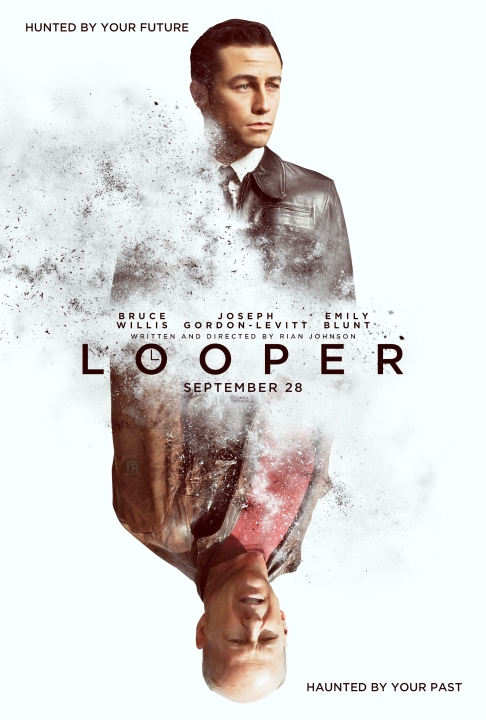
Culture Shock 01.31.13: 'Looper' is cinematic sleight of hand


Trying to wrap your head around time travel can give you a headache.

If you're Marty McFly, you have Doc Brown to explain it to you. If you're Bruce Willis' character in "Looper," you down handfuls of aspirin because time travel literally gives you a headache.

One must forgive any time travel movie its occasional plot holes or lapses in logic. The thing about time travel, by its very nature, is it creates plot holes. In the language of the genre, they're called "temporal anomalies." If you've seen any "Star Trek" after the original series, you've likely heard of them. But good filmmakers are clever enough to disguise them or make them part of the story or at least divert your attention from them.

With "Looper," writer/director Rian Johnson ("Brick") tries a little of all three and delivers one of the smartest, most entertaining science-fiction films in years — and one of the best films of the past year. Add another to the list of Oscar snubs.

"Looper" (Blu-ray and DVD) is set in the near future, around 2044. A few decades later, in 2074, our narrator tells us, time travel will be invented — and immediately outlawed. This works about as well outlawing liquor in the 1920s or marijuana today. When the mob wants to off someone, it sends them back in time to the 2040s, where paid assassins await the easy, untraceable kill.

The ubiquitous Joseph Gordon-Levitt ("The Dark Knight Rises") plays Joe, one of the mob's hired guns in 2044. These hired guns are called "loopers" because when the mob of the future decides to cancel their contracts, it sends the loopers' older counterparts back in time to be killed by their younger selves, completing the loop and leaving no loose ends. In return, the younger version earns a windfall retirement package.

That may seem like a bad deal, but as Joe says, the job doesn't exactly attract forward-thinking people. It attracts reckless young punks who doubt they'll even live another 30 years.

So, Joe lives the good life, while he can, bumping off people from the future and stockpiling silver until he suddenly finds his future self (Willis) on the other end of the gun.

And Old Joe does the unthinkable. He escapes.

Old Joe is trying to change the future, Young Joe is trying to kill Old Joe, and the mob — led by a charmingly droll Jeff Daniels ("The Newsroom") — is trying to eliminate both Joes. But that's not the half of it.

The bigger mystery comes into play when Young Joe, on the run, hides out with a young mother (Emily Blunt) and her brilliant but unsettling son, Cid (Pierce Gagnon).

Johnson pulls a few fast ones on us. First, he violates H.G. Wells' rule of science fiction: Change one thing and see what follows from it. Johnson changes two things. He introduces time travel, but he also posits humans who develop low-level telekinetic powers — an idea worth its own movie. It seems like a throwaway plot point at first, but it ends up being crucial.

Second, he covers up his biggest time-travel plot hole with a cinematic sleight of hand. If Old Joe escapes in 2044, how does Young Joe live out his life normally so he can he sent back in 2074? Johnson dodges the question by shifting the perspective. It goes from Young Joe to Old Joe remembering his days as Young Joe. It's a bit of a cheat, but all time travel stories are, and Johnson carries off his bait-and-switch so deftly you'd have to be a real curmudgeon to complain.

On the surface, "Looper" is a time-travel movie, but it's really about how we view the passage of time. Are we in it only for the short run? Can we sacrifice in the now for the sake of the future?

These are the sort of questions we ask ourselves all the time. We just don't have the future literally staring us in the face.

Thursday, January 24, 2013

Culture Shock: 01.24.13: 'Dredd' lays down the letter of the law


In the near future, Mega-City One stretches across the Eastern Seaboard. Within its concrete and steel canyons, hundreds of millions of people live, walled off from the war-ravaged wastelands to the west. Outside is desolation. Inside is a vast, crowded, chaotic city-state beset by warring gangs.

The only thing keeping law and order are the judges. Each one is judge, jury and, if the punishment fits the crime, executioner. They are the law. And the most feared judge of all is Judge Dredd.

"Dredd" is the second attempt to bring the long-running British comic-book character to the screen. The first, 1995's "Judge Dredd" starring Sylvester Stallone, set new standards for bad decisions and bad acting. The new "Dredd" (Blu-ray and DVD) is at least respectful of its source material, but it never embraces the comic's black humor and subversive critique of authority. It has less ambitious goals in mind.

Take "The Rookie" starring Clint Eastwood and Charlie Sheen, cross it with the first "Die Hard," set it in the future, and you pretty much have "Dredd."

After taking down a van full of gang members high on a new drug called "slo-mo," which makes time appear to move in slow motion, Dredd (Karl Urban of the rebooted "Star Trek") is assigned to give a final pass/fail field test to a trainee judge, Anderson, played by Olivia Thirlby of "Juno."

Anderson is a borderline case who shouldn't even have made it to the field-test stage, but she has a quality that makes giving her a final shot worthwhile: She is a mutant with psychic abilities, the result of her having grown up near the wall separating Mega-City One from the radioactive wastes.

But because this is a movie, it's not going to be a typical training exercise.

Investigating a triple-homicide call leads to Dredd and Anderson becoming trapped in Peach Trees, a 200-story skyscraper slum ruled by Ma-Ma (Lena Headey of "Game of Thrones"), a former prostitute who has built a criminal empire, including control of Mega-City One's slo-mo trade.

With limited ammunition and no backup, Dredd and Anderson must blast their way up and out of Ma-Ma's locked-down fortress, with her army on their heels and hundreds of civilians in the crossfire.

Headey is very good in her stereotypically male role as the ruthless, disfigured villain, and Thirlby gets the movie's best set piece when she goes inside the mind of Ma-Ma's top lieutenant. But most of the credit goes to Urban, who stays true to his character by never removing his helmet, even though it means he can act only with his chin. Urban's enigmatic Dredd, keeping his thoughts and expressions to himself, is a marked improvement on Stallone's screaming buffoon.

Director Pete Travis and his team, with a relatively modest budget, deliver a convincing post-apocalyptic setting and a few first-rate action scenes. In the end, "Dredd" is a perfectly competent and enjoyable action film.

The only problem is it could have been much more, and at no extra cost.

Since its inception in 1977, the "Judge Dredd" comic, appearing in the British magazine 2000 A.D., has been filled with political and social satire. It has attracted some of the British comics industry's top talent, and it helped inspire the politically aware comic books that took America by storm in the 1980s, from Alan Moore and Dave Gibbons' "Watchmen" and Howard Chaykin's "American Flagg" to Mike Baron and Steve Rude's "Nexus" and Frank Miller's "The Dark Knight Returns." But you'd never get that impression from the movie "Dredd," which plays the absurd, madcap universe Dredd inhabits almost totally straight.

"Judge Dredd" co-creator Carlos Ezquerra says that when he created Dredd's costume, with its hints of fascist iconography, he intended it to be futuristic, but now some police actually dress the same way.

So, maybe "Dredd" the movie doesn't bother with satire because it's beside the point?

Thursday, June 14, 2012

Culture Shock 06.14.12: Not much spark from this 'Prometheus'


Thirty-three years after he showed us that in space no one can hear you scream, director Ridley Scott returns to the movie franchise he unsuspectingly launched with 1979's horror/sci-fi masterpiece "Alien."

But with this very loose prequel, you'll scream more out of frustration than fright.

"Prometheus" is exasperatingly thick-headed sci-fi masquerading as smart science fiction.

As with a 1980s slasher movie, it's the kind of film where the plot moves forward only because the characters are idiots. While that's excusable when you're dealing with frisky teenagers and camp counselors, it's unforgivable when you're dealing with the hand-picked crew of a scientific research ship bound for a distant moon, light years away from Earth and any hope of rescue.

These people are presumably professionals and actually follow safety protocols.

Well, if you really think that, you're wrong.

"Prometheus" opens with an alien seemingly sacrificing himself in order to seed a planet — maybe Earth — with his DNA. It's the first of many symbolic moments involving life, death, sacrifice and life from death.

These are eternal themes, but they deserve more coherent treatment than what they get from "Prometheus" screenwriters Jon Spaihts and Damon Lindelof, the man who executive produced "Lost" to a unsatisfying end.

Flash forward to an archaeological expedition on Earth, decades in our future. Two scientists, Elizabeth Shaw (Noomi Rapace, of "The Girl with the Dragon Tattoo") and Charlie Holloway (Logan Marshall-Green) uncover a 30,000-year-old cave drawing of a giant alien seemingly giving us directions to a point in the heavens.

Flash forward a few more years, and the ship Prometheus has arrived in orbit around the alien moon.

Awakened from two years in suspended animation, Elizabeth informs the crew of biologists and geologists and other experts they're there to find the aliens she believes created life on Earth. And when one crew member expresses some skepticism about this wild claim, Elizabeth admits she has no evidence, but "it's what I choose to believe."

Shaw is a religious zealot, and so is Peter Weyland (Guy Pearce in the least-convincing old-man makeup ever), the dying gazillionaire whose corporation bankrolled the expedition. And so, too, are the aliens. At least that's one interpretation.

Unfortunately, it isn't just that "Prometheus" is ambiguous, which can be a virtue, but that it doesn't seem to know where it's going with any of its ideas. And when it comes down to the basic stuff, it fails miserably.

It isn't just a matter of characters doing stupid things. As boneheaded as the characters are, the science of "Prometheus" is worse. We're told the aliens and humans have identical DNA. Not similar, but identical, and this is a major plot point. But if true, this would mean the aliens are just ordinary humans, and clearly they are not.

The treatment of genetics and evolutionary biology in "Prometheus" contradicts all known science. It's creationism with extraterrestrials.

Yet the biggest problem with "Prometheus" is the way it wastes everything good about it. A scene involving an emergency surgery is as harrowing as anything in "Alien," the production design is gorgeous and Michael Fassbender delivers a brilliant, eerie performance as the android David, who emerges as the only likable character even when he's up to something suspicious.

The good points, including Scott's direction, are overwhelmed by the flawed screenplay.

Yes, "Prometheus" makes you think. But the more you think about it, the less sense it makes.