Showing posts with label bruce willis. Show all posts
Thursday, January 31, 2013
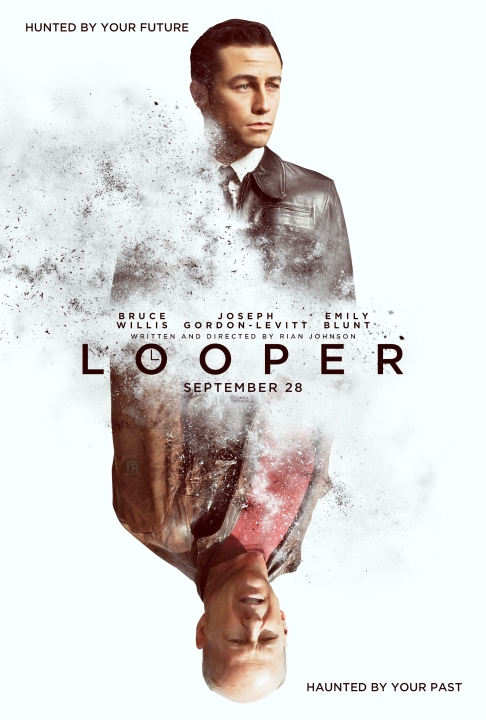
Culture Shock 01.31.13: 'Looper' is cinematic sleight of hand
Trying to wrap your head around time travel can give you a headache.
If you're Marty McFly, you have Doc Brown to explain it to you. If you're Bruce Willis' character in "Looper," you down handfuls of aspirin because time travel literally gives you a headache.
One must forgive any time travel movie its occasional plot holes or lapses in logic. The thing about time travel, by its very nature, is it creates plot holes. In the language of the genre, they're called "temporal anomalies." If you've seen any "Star Trek" after the original series, you've likely heard of them. But good filmmakers are clever enough to disguise them or make them part of the story or at least divert your attention from them.
With "Looper," writer/director Rian Johnson ("Brick") tries a little of all three and delivers one of the smartest, most entertaining science-fiction films in years — and one of the best films of the past year. Add another to the list of Oscar snubs.
"Looper" (Blu-ray and DVD) is set in the near future, around 2044. A few decades later, in 2074, our narrator tells us, time travel will be invented — and immediately outlawed. This works about as well outlawing liquor in the 1920s or marijuana today. When the mob wants to off someone, it sends them back in time to the 2040s, where paid assassins await the easy, untraceable kill.
The ubiquitous Joseph Gordon-Levitt ("The Dark Knight Rises") plays Joe, one of the mob's hired guns in 2044. These hired guns are called "loopers" because when the mob of the future decides to cancel their contracts, it sends the loopers' older counterparts back in time to be killed by their younger selves, completing the loop and leaving no loose ends. In return, the younger version earns a windfall retirement package.
That may seem like a bad deal, but as Joe says, the job doesn't exactly attract forward-thinking people. It attracts reckless young punks who doubt they'll even live another 30 years.
So, Joe lives the good life, while he can, bumping off people from the future and stockpiling silver until he suddenly finds his future self (Willis) on the other end of the gun.
And Old Joe does the unthinkable. He escapes.
Old Joe is trying to change the future, Young Joe is trying to kill Old Joe, and the mob — led by a charmingly droll Jeff Daniels ("The Newsroom") — is trying to eliminate both Joes. But that's not the half of it.
The bigger mystery comes into play when Young Joe, on the run, hides out with a young mother (Emily Blunt) and her brilliant but unsettling son, Cid (Pierce Gagnon).
Johnson pulls a few fast ones on us. First, he violates H.G. Wells' rule of science fiction: Change one thing and see what follows from it. Johnson changes two things. He introduces time travel, but he also posits humans who develop low-level telekinetic powers — an idea worth its own movie. It seems like a throwaway plot point at first, but it ends up being crucial.
Second, he covers up his biggest time-travel plot hole with a cinematic sleight of hand. If Old Joe escapes in 2044, how does Young Joe live out his life normally so he can he sent back in 2074? Johnson dodges the question by shifting the perspective. It goes from Young Joe to Old Joe remembering his days as Young Joe. It's a bit of a cheat, but all time travel stories are, and Johnson carries off his bait-and-switch so deftly you'd have to be a real curmudgeon to complain.
On the surface, "Looper" is a time-travel movie, but it's really about how we view the passage of time. Are we in it only for the short run? Can we sacrifice in the now for the sake of the future?
These are the sort of questions we ask ourselves all the time. We just don't have the future literally staring us in the face.
Thursday, July 12, 2012
Culture Shock 07.12.12: Sticking it to The Man in 'Moonrise Kingdom'
Clever children having to deal with not-so-clever adults is a movie trope that's far older than either Macaulay Culkin or the Goonies, and with good reason.
It's the ultimate empowerment fantasy played out against the first authority figures any of us encounter: grownups.
Director Wes Anderson's cinematic children are probably better equipped to take on The Man than most. They're ridiculously smart and preternaturally wise for their age, although not as wise as they think they are. But who is?
The Tenenbaum siblings of Anderson's 2001 film "The Royal Tenenbaums" are all child prodigies. Unfortunately, they grow up to be sad, dissatisfied and just plain messed-up adults, pretty much like most of Anderson's other adults.
If only we could all be like Peter Pan and fly away to Never Never Land and never grow up.
Perhaps that's just what Sam and Suzy, engagingly played by newcomers Jared Gilman and Kara Hayward, have in mind when they run away from home in Anderson's latest movie, "Moonrise Kingdom."
Set in a small New England island community in the mid-1960s, "Moonrise Kingdom" manages to be simultaneously nostalgic for a more innocent time that never was, yet clinically unsentimental about the whole nostalgia business. It's the cool, detached approach that has become Anderson's calling card, and which he perfects here, with the aid of co-screenwriter Roman Coppola, director of the criminally overlooked film "CQ." Amazingly, the result is also — dare I say? — heartwarming.
Both Sam and Suzy are classified as "problem children." They read too much and have ideas of their own. So when first love hits them, they run off, camping gear and borrowed record player in hand, on an adventure.
Not exactly hot on their trail are Sam's well-meaning but clueless scout master (an unusually likable Edward Norton), sad sack policeman Capt. Sharp (Bruce Willis) and Suzy's unhappily married parents, Walt and Laura (Bill Murray and Frances McDormand).
With their bad marriages and bad careers and lost loves, the adults are a pretty miserable bunch. It's telling that the only grownup character who has his act together throughout is Bob Balaban's omniscient narrator, who hints to us at the very beginning that he's read ahead in the script.
Basically, he cheated.
The screenplay is full of great lines, and Norton and Murray are both in scene-stealing form, but none of that would matter if Gilman and Hayward weren't up to the challenge. They carry the film and make it seem easy, which is likely a testament to Anderson's direction.
This is filmmaking with authority, which is ironic given that authority appears to be Anderson and Coppola's main target for ridicule. No authority figure is left unscathed, whether it's Capt. Sharp and his deflated ego or the pompous woman from Social Services — identified simply as "Social Services" and played with bureaucratic bluster by Tilda Swinton.
The only people who seem capable of carrying out a plan are our young protagonists and, later on, Sam's fellow scouts.
Minor spoiler: It's no accident that Norton's Scout Master Ward only has his moment of triumph after being relieved of command.
This is a more hopeful Wes Anderson than we've seen before. He leaves us charmed and cautiously optimistic. Maybe, unlike those Tenenbaum kids, Sam and Suzy will grow up to be OK.
Subscribe to:
Comments (Atom)

