Thursday, April 19, 2007

Culture Shock 04.19.07: Vonnegut, Bob Clark leave enduring legacies

Writer Kurt Vonnegut and filmmaker Bob Clark are two men whose names you'd never expect to see together in a single sentence.

And you wouldn't see them together now had Vonnegut and Clark not died within days of each other.

Vonnegut died April 11 from brain injuries he suffered in a fall weeks earlier. Clark, along with his son, died April 4 when his car collided with a sport utility vehicle driven by an alleged drunk driver.

In books like "Slaughterhouse-Five" and "Breakfast of Champions," Vonnegut voiced the disaffection both of his own generation, which fought in World War II, and of the Vietnam era. You know "Slaughterhouse-Five" is important because it is both required reading for students and frequently banned from public schools.

Clark's importance is less obvious. As a director, he'll never rank among the top tier. But his films are easily among the most culturally significant of the past 30 years.

I was still in high school when I read every one of Vonnegut's books the local library had. They included "Breakfast of Champions" and several of his lesser efforts. I didn't get to the undisputed classics like "Slaughterhouse-Five" and "The Sirens of Titan" until later.

His short, declarative sentences and black humor are tailor-made for cynical teens. It's only when you're older that you can appreciate the underlying humanism of Vonnegut's works. He's mad at the world because he wants it to be better, even if he really doesn't have much hope for that.

My favorite of his short stories is "Harrison Bergeron," reprinted in "Welcome to the Monkey House." It begins, "The year was 2081, and everyone was finally equal."

The story is as strong an indictment of the implications of socialism as you'll ever read. And Vonnegut was an admitted socialist. Which probably explains why he was so bitter.

Vonnegut was a prisoner of war in Dresden, Germany, when the Allies firebombed the city, an event central to "Slaughterhouse-Five" and to Vonnegut's whole worldview. He faced his own mortality long before it faced him.

When he died, my friends filled their online journals and blogs with Vonnegut quotes, most dealing with death. Several quoted from "Slaughterhouse-Five." In it, a race of extraterrestrials, the Tralfamadorians, can see in four dimensions — the fourth being time. Since they can see any moment in a person's life, they view death as no big deal. There are always moments when the person is still alive. As the Tralfamadorians say of death, "So it goes."

"Galapagos," a novel often cited as Vonnegut's worst (or least good), has one amusing conceit. A few pages before any character dies, an asterisk appears beside his or her name.

Put the two books together, and we're always alive, but with asterisks floating beside us. Like all true Americans, Vonnegut was full of contradictions.

And so was Clark.

He started out directing low-budget horror films. His 1974 movie "Black Christmas" became the model for slasher films, predating John Carpenter's more famous film, "Halloween," by four years. And like most good horror films, Hollywood has remade it.

Clark then directed 1982's "Porky's" and its sequel, "Porky's II: The Next Day," thus inventing the modern teen sex comedy. "Porky's" lineage leads directly to the "American Pie" franchise.

But Clark's defining moment came in 1983, when he directed "A Christmas Story."

Based in the stories of Jean Shepherd, "A Christmas Story" is now a holiday classic, aired 24 hours straight on Christmas Day, a role formerly reserved for "It's a Wonderful Life."

From there, Clark's career descended to "Rhinestone" and "Baby Geniuses," but he'd already made his mark on the culture.

"Black Christmas," "Porky's" and "A Christmas Story" make for one improbable resume. But those films form a legacy that will keep Clark with us for years to come.

Thursday, April 12, 2007

Culture Shock 04.12.07: Reliving the era of exploitation

It was a golden age, when anything seemed possible.

Throughout the 1970s, teenagers swarmed to rural drive-ins to make out beneath a flickering glow of horror and exploitation. New York City's 42nd Street was a den of iniquity, where seedy "grindhouse" theaters screened everything from kung-fu films and soft-focus porn to blaxploitation and revenge yarns like "They Call Her One Eye."

Zombies, madmen, criminals, cannibals, prisons full of violent women with lesbian tendencies, Nazis and hormonally charged teens mingled on the silver screen in an orgy of celluloid sin.

Then it ended. Multiplexes drove the drive-ins into the ditch, and former New York City mayor and current presidential candidate Rudy Giuliani turned 42nd Street into a sanitized tourist trap — a Disneyland without the lines.

But nostalgia for the grindhouse era is in full bloom, and not because of Quentin Tarantino and Robert Rodriguez's aptly titled double bill "Grindhouse." It opened last week to positive reviews but disappointing profits, in part because of its three-hour-plus running time, and in part because no one in the South or Midwest knows what a grindhouse is.

Grindhouse. n. an often shabby movie theater having continuous showings especially of pornographic or violent films.

Those of us in rural America grew up with drive-ins, not grindhouses. But the movies were the same.

Boutique DVD labels are raiding the vaults of long-gone movie distributors in search of exploitation films no one has seen since the first generation of mom-and-pop video stores liquidated their worn VHS stock.

Synapse Films has found a niche selling DVD compilations of exploitation movie trailers. To date, there are three volumes of "42nd Street Forever." The first two cover a cross-section of trash cinema, while the third, adults-only disc focuses exclusively on movies with lots of heavy breathing, if you know what I mean.

Books like Jacques Boyreau's "Trash: The Graphic Genius of Xploitation Movie Posters" celebrate the lurid, pop-art posters that once lured people into theaters showing "Blood Feast" and "The Centerfold Girls."

But not everyone is celebrating. Slate.com's Grady Hendrix writes, "The affection people have today for exploitation movies is misplaced, because these movies stink."

There's no accounting for taste, but I'll take "Faster, Pussycat! Kill! Kill!" over "Titanic." And who can deny that a truly bad movie is more entertaining than a merely mediocre one?

Hendrix makes one point that is almost true: "Exploitation movies are as dead as disco today because every movie is an exploitation movie."

Yes, recently we've seen a revival of exploitation, including "Hostel" and Rob Zombie's "House of 1,000 Corpses" and "The Devil's Rejects." But these gory, mainstream throwbacks are tame compared to, say, "Ilsa, She Wolf of the SS." Even low-rent, direct-to-DVD films don't go there.

Modern filmmakers can get away with only so much. If it's Nazisploitation you want, you'll have to settle for Zombie's fake trailer for the nonexistent movie "Werewolf Women of the SS," sandwiched between the two features of "Grindhouse."

The most extreme '70s exploitation films are morally challenging. They make audiences complicit in the onscreen acts. A viewer who walks out of "I Spit on Your Grave" unshaken has missed the point.

At the other end of the spectrum, exploitation movies, however bad, are just plain fun. And they're fun in ways their modern, direct-to-DVD descendents are not. Maybe it's because they were shot on film rather than on videotape, and maybe it's because their actresses didn't have silicone enhancement. But there is an authenticity to '70s exploitation that '00s exploitation can't match.

Thursday, April 05, 2007

Culture Shock 04.05.07: You know, I learned something today

Books with titles like "Monty Python and Philosophy" and "The Lord of the Rings and Philosophy" fill bookstore shelves.

For some academics, it's symbolic of a commercial culture that trivializes important subjects. But for others, it reflects how popular culture translates big ideas into a language the average person — who has never so much as cracked open a copy of Aristotle or Wittgenstein — can understand.

You can find pop-philosophy books dealing with everything from "Star Trek," "Harry Potter" and "Buffy the Vampire Slayer" to "The Simpsons," "The Sopranos" and the films of Woody Allen.

Chicago-based Open Court Publishing dominates the market with its Popular Culture and Philosophy series. Open Court is a mainstream philosophy publisher. The company's editorial director, David Ramsay Steele, is author of the heady tome "From Marx to Mises: Post-Capitalist Society and the Challenge of Economic Calculation." (I've read it, and it's serious stuff.)

But as the company's chief executive officer told a Forbes Small Business reporter in 2004, Open Court stumbled onto a financial bonanza in 2001 with its first pop-culture volume, "Seinfeld and Philosophy." It sold 7,000 copies its first year, which doesn't sound like much but is a respectable figure for a philosophy book.

Success breeds imitation, which is why there are two books titled "South Park and Philosophy," one from Open Court and one subtitled "You Know, I Learned Something Today" from Blackwell Publishing, which has its own philosophy/pop-culture imprint.

No pop-culture subject is immune from serious philosophical scrutiny. Superhero tales are, for the most part, morality plays dressed in capes, and "Superheroes and Philosophy" spends a lot of pages examining the ethical and political implications of vigilante justice. The book's best chapter is former Auburn University professor Aeon J. Skoble's essay on the graphic novels "Watchmen" and "The Dark Knight Returns."

Of course, some works of popular culture are explicitly philosophical, like "The Matrix" and its sequels.

The sequels get bogged down in self-importance, but the original manages to touch on several major philosophical controversies without forgetting to entertain. "The Matrix and Philosophy" examines many of them, my favorite being the question of whether living in a virtual-reality simulation is a rational alternative to life in the real world.

That problem has stumped freshmen philosophy students since it appeared in late Harvard philosopher Robert Nozick's 1974 book "Anarchy, State and Utopia," arguably the 20th century's most influential work of political philosophy.

Nozick calls his thought experiment "the experience machine." He asks that we imagine ourselves as disembodied brains connected to a machine that can give us any experience we want. As he sketches his argument, he shows that such experiences, however pleasurable, are inferior to life in the real world because there are things like truth that are more important than mere pleasure.

But I know of at least one philosophy professor who, year in and year out, has freshmen classes who overwhelmingly say they'd prefer to spend their entire lives hooked up to Nozick's experience machine. That alone tells me we need philosophy books aimed at a popular audience. Otherwise we'll have a generation of college students who welcome their robot overlords!

Thursday, March 29, 2007

Culture Shock 03.29.07: Wii breaks the mold for video game consoles

After years of being an also-ran, Nintendo is riding high again with its new Wii video game console, which has become the must-have system by breaking all the rules.

Gamers can be fiercely partisan when it comes to their favorite game systems, so I'll start by saying I don't have a Mario Kart in this race. I haven't owned a console game system since the Atari 2600, and the last PC game I bought was Diablo II. My idea of a killer application is Pitfall.

I know. I'm showing my age.

Currently, sales of Nintendo's Wii have outpaced by about 2-to-1 those of Sony's new PlayStation 3. In January, Wii sales also surpassed sales of Microsoft's Xbox 360.

How did Wii become the No. 1 game system?

It wasn't by beating PS3 and Xbox at their own game. Rather, it was by starting a whole new game. Wii hit the "reset" button in the console wars.

Before Wii came along, Nintendo, Sony and Microsoft were locked in an arms race. Each new game system was faster, more powerful and more versatile than the one that came before it. But after PS2 and the first version of Xbox trounced Nintendo's GameCube, Nintendo had to find a new strategy or risk going the way of Sega, which abandoned the console business after its Dreamcast failed to catch on.

That would have been a sad end for Nintendo's game console division, which had reinvigorated the home video game market in the mid- and late 1980s, after the early '80s Atari boom went bust.

But with Wii, Nintendo has changed the playing field. Wii forces players to get off their sofas and truly interact with the games. When you play Wii bowling or tennis, you're literally going through the motions of playing the game in real life. This has the added advantage of making game play simple enough for even the least tech-savvy player.

So, I wasn't really surprised to read a Reuters story last week about a retirement community where residents organized their own Wii bowling tournament.

When 80-year-olds are playing video games, something strange is going on. After all, these are people who didn't even play Pac-Man when they were young.

Wii making players more active participants in the game experience is a natural evolution. And we can see where it's heading — toward the sci-fi dream of virtual reality, in which players don't merely play a game, they're part of it.

Don't expect Sony and Microsoft to sit back while Nintendo gobbles up market share. They'll develop responses to Wii just like they came up with bigger and better consoles to compete with the Nintendo Entertainment System and the Super NES back in the 1990s.

Imagine a game with the intuitive, immersive game play of the Wii combined with the cutting edge graphics of the PS3. And if you can't imagine it, someone at Sony probably already has.

And when someone comes up with a role-playing or fighting game that plays like one of the sports games for Wii, Nintendo may find itself back on the defensive.

In the breakneck world of technological innovation, video game companies are the ones that can least afford to rest on their last big breakthrough.

Thursday, March 22, 2007

Culture Shock 03.22.07: Commie zombies haunt the world

When Karl Marx told the workers of the world to unite because they had nothing to lose but their chains, I don't think he had zombies in mind.

But given the fall of the Soviet Union and the fact that the world's only practicing Marxists run Venezuela, Cuba and the workers' paradise of North Korea, it's clear that prediction wasn't Marx's strength.

To get back to the issue at hand, however, what do zombies have to do with the man who co-authored "The Communist Manifesto"?

Answer: everything.

Marxist class analysis, in one form or another, has been part of zombie movies since there was such a thing as zombie movies. It's evident as early as the low-budget 1932 shocker "White Zombie," starring Bela Lugosi as one of the most memorably named characters in cinema, "Murder" Legendre, who uses zombies as workers in his mill.

According to Marx, class struggle is history's defining characteristic.

In the 1800s, with capitalism on the rise, Marx saw the upper class, the bourgeoisie (owners of capital and businesses), as being in conflict with the wage-earning masses, or proletariat. Eventually, as Marxist dogma would have it, the proletariat would rise up to overthrow the bourgeoisie.

Marx died in 1883, and 124 years later, the only communist revolutions that have occurred have taken place in poor countries with little or no capitalist class at all. But that Marx has been proven wrong doesn't mean his ideas have died. Like zombies, they keep shambling along.

Which again brings us back to zombie movies.

In zombie movies, we are the bourgeoisie and the zombies, which have nothing but numbers on their side, are the proletariat.

When people think of zombie movies, they usually think of George Romero's black-and-white classic "Night of the Living Dead," released in 1968. But before Romero began his franchise, Hammer Films, the British studio behind the Christopher Lee "Dracula" series, unleashed "The Plague of the Zombies."

"Plague" takes the political undercurrent of "White Zombie" a step further while dispensing with the Lugosi film's damsel-in-distress plot. In "Plague" British mine workers, a symbol of labor if ever there was one, turn into zombies and create havoc for the upper classes.

By the time Romero got around to his fourth "Dead" film, "Land of the Dead," in 2005, the political message had graduated from subtext to the whole point of the exercise. Dennis Hopper plays the upper-class ruler of an upscale residential development where the idle rich live in relative splendor amid the ruins of zombie-infested America. It all comes crashing down when the zombies break in and eat the rich.

Other zombie films are variations on the theme. Romero's "Dawn of the Dead" takes place in a shopping mall and casts the zombies as mindless consumers. His subsequent "Day of the Dead" and director Danny Boyle's "28 Days Later" pit zombies against the military, standing in for the military-industrial complex.

Of course, none of these films paints a flattering picture of the proletariat, which is portrayed as mindless zombies. But in "Land of the Dead," Romero tried to make his zombies smarter and more sympathetic, with mixed results.

The irony of most zombie films is that their political slant favors subhuman monsters that feed on the brains of the living. Filmmakers compensate by making most of their living characters so nasty or stupid they deserve to be eaten.

If Ayn Rand had written zombie movies instead of 1,000-page novels, she would have had an easier time of it — heroic capitalists vs. mindless zombie hordes hungering for the brains of the creative class.

That script writes itself: Capitalists of the world unite! You have nothing to lose but your brains.

Thursday, March 15, 2007

Culture Shock 03.15.07: Captain America is just resting

Captain America is dead. Long live Captain America!

There is a temptation to view Cap's demise as a kind of metaphor. Is it the death of patriotism? The death of the American dream? The death of the nation's innocence in a post-9/11 world?

Oh, sure, I could join in the chorus of commentators searching for meaning in the demise of a fictional character. But how could I sleep at night?

For those of you just coming in, Captain America died last week in issue No. 25 of either the fifth or sixth volume — depending on how you count them — of his self-titled comic book. He was shot while being escorted into a federal courthouse to be arraigned on charges of some sort.

Wait a minute. Captain America under arrest? How can this be?

It was the fallout from Marvel Comics' most recent "nothing will ever be the same again" miniseries, "Civil War," in which, instead of fighting villains, superheroes fought each other over the issue of whether they should have to register with the government.

Of course, when superheroes fight, things, like entire cities, get broken. And when Cap's side — the anti-registration heroes — lost, Captain America was hauled in to stand trial.

The bottom line is that Cap's death was simply the dramatic payoff to a months-long story line of interest to only the most obsessive fans of superhero comics. Ultimately, it is meaningless, except as a way for Marvel Comics to grab some headlines and sell a few more books. "Captain America" No. 25 is already sold out at most retailers and going for about $25 on eBay. A second printing is due in stores later this month.

If all of this seems familiar, it's because we've been through it before.

Superman died in 1993. He got better. But not before his death became big news and DC Comics milked it for a year, during which four pretenders to the Man of Steel's legacy reigned.

Expect pretty much the same for Captain America.

He'll be back within a year or two, if not sooner. In the meantime, someone else will put on Cap's red, white and blue costume to fight the forces of evil.

A good candidate for Cap's fill in is his former sidekick, Bucky, who, for reasons too complicated to relate here, now goes by the name Winter Soldier. And that would be ironic, seeing as how Bucky himself came back from the dead just two years ago, after having been officially dead since either 1964 (our time) or 1945 (comic-book time).

For most superheroes, death isn't much of a problem. Off the top of my head, I can think of lots of heroes who have died and come back: Green Lantern (Hal Jordan), Green Arrow, Wonder Man, Wonder Woman, Robin (Jason Todd), Nick Fury, Mr. Fantastic and Hawkman, just for starters. It's not much of an exaggeration to note that every member of the X-Men has died and come back at least twice. Thor is still dead but is scheduled for resurrection later this year.

You only really have to worry if you're a C-list hero. DC Comics has declared open season on its lesser-known characters. Within the past couple of years, Firestorm, Blue Beetle and The Question, have met untimely ends. But DC has replaced all of them with new characters using the same names.

So, don't shed any tears for Cap. He's beaten the Red Skull, and he'll beat death, too.

Old superheroes never die. They don't even fade away.

Thursday, March 08, 2007

Culture Shock 03.08.07: Documentary takes on the hypocritical film ratings

The system used to rate the content of movies isn't all it appears to be. And that's a problem both for parents and filmmakers.

The Motion Picture Association of America's ratings system has been in place for about four decades. It has been modified twice, first with the introduction of the PG-13 rating, and later with the substitution of the NC-17 rating for X, which had come to be associated exclusively with hardcore pornography, as opposed to tamer "adult" films like "Showgirls."

But those small tweaks can't make up for the fact that the MPAA's system is broken and should be scrapped entirely.

Documentary filmmaker Kirby Dick set out to learn just how the MPAA rates films. The result was his 2006 movie, "This Film Is Not Yet Rated," recently released on DVD. The title refers to the standard disclaimer used on ads for films awaiting an MPAA rating.

Dick learned that the MPAA's supposedly impartial ratings system is anything but. But he had to hire a private investigator to do it.

The board that rates films for the MPAA is kept top secret, supposedly to shield its members from outside pressure. It is supposed to be made up of parents with small children.

Dick's investigator learned, however, that several of the board's members didn't have school-aged children. Others had ties to major movie studios. And, on top of that, two representatives of major religious groups served in "advisory" capacities.

In interviews with filmmakers, Dick found that independent films are held to a higher standard than are major studio releases. "This Film Is Not Yet Rated" was itself slapped with the dreaded NC-17, even though its content seems to merit only an R. (Dick released the final cut of the film without an MPAA rating.)

Then, of course, there is the longstanding criticism, which Dick notes, that the MPAA has a double standard for violence. Extreme violence earns a film a PG-13 or R. But too much sex can get a film an R or NC-17. Which are you really more concerned about your children viewing?

"This Film Is Not Yet Rated" leaves little doubt that the MPAA's ratings system benefits its member studios at the expense of independent films. Which is just what it was really intended to do. That's no surprise when you consider that the father of the ratings system, former MPAA President Jack Valenti, was a political hack in the Johnson administration. He had made a career out of crushing enemies, real and imagined.

Of course, Valenti sold it to the public as a tool for parents and a way to ward off any kind of government-run ratings system. Big corporations have a history of using the threat of government action to scare their smaller competitors into going along with things that end up benefiting only the big corporations.

One lawyer interviewed in Dick's film, however, says he'd prefer a government-run ratings system because he has no doubt it would be found unconstitutional. I think he is far too optimistic about the Supreme Court's ability to read the U.S. Constitution, but I can see his point.

Dick's film is strongest when it stays on message. A digression about "media consolidation" is simply factually incorrect. And in a discussion included on the DVD as a bonus feature, Dick downplays the MPAA's waning influence. Clearly, however, as more people view movies at home rather than in theaters, ratings are less of an issue. Unrated versions of films are widely available, even at retailers that claim to avoid racy entertainment.

Quibbles aside, "This Film Is Not Yet Rated" is a powerful indictment of the MPAA's self-serving, hypocritical approach to rating films.

Thursday, March 01, 2007

Culture Shock 03.01.07: Loving celebrities is in our genes

It's a common complaint: People are too interested in trivial celebrity gossip and pay too little attention to real news. And the mass media fosters this "culture of celebrity" by pandering to it, while coverage of important issues suffers.

Instead of reporting on the war in Iraq and the state of the economy, the argument goes, cable news channels offer hours of coverage of the Anna Nicole Smith legal battles, Britney Spears' shaved head and Madonna's latest trip to Africa in search of some unsuspecting child to adopt.

In the stuffy neoconservative magazine The Weekly Standard, Joseph Epstein writes "Without celebrities, whole sections of the New York Times and the Washington Post would have to close down."

The assumption, usually unspoken, is that the culture of celebrity is something new, something forced on us by "crass consumerism" and media saturation. All I needed, however, was a quick Google search to find some genuine, capitalism-hating Marxists making the point forthrightly.

A blogger at RadicalLeft.net writes disparagingly of Andy Warhol's pop art. Warhol, you see, had the gall to turn celebrity and pop culture into an art form. The same blogger also slams Oprah Winfrey: "... Oprah, whose fetishizing of celebrity and high-end consumer goods is legend, has fed that compulsive consumerism as much as anyone in modern media."

There is no doubt that capitalism produces more — better, faster and less expensively. That is why the capitalist West was growing rich while people in the former Soviet Union were standing in lines for hours to buy toilet paper. Capitalism and the mass media make celebrity gossip, and even the rare instance of real celebrity news, convenient and inexpensive for anyone who wants it.

But they don't create the demand for it.

People have been obsessed with celebrities going virtually as far back as our written records take us. Archaeologists have found graffiti about famous gladiators of the day scrawled on ancient Roman ruins. And ancient Greek athletes had cult-like followings.

Our collective interest in the lives of celebrities has been with us all along because, like most human behavior, it has its roots in our genes.

Celebrities, after all, are not like the rest of us. Some are bigger, stronger and faster. Others are prettier. Others still are just stranger. They stand out.

In prehistoric times, those were the sorts of qualities that helped get you a mate, enabling you to pass on your genes to the next generation. And genes are all about being passed on.

To get an idea how this works in practice, it helps to think about birds. In many bird species, males have brightly colored plumage. This makes them easier prey for predators, but the females love it. Attractive feathers are so useful when it comes to finding a mate that the advantage outweighs the disadvantage of possibly being eaten. Male peacocks in particular have elaborate tails that require a lot of extra calories to maintain. This would be an evolutionary minus if not for the fact that those otherwise useless tails drive the ladies wild.

Paris Hilton is the human equivalent of a peacock. She is mostly useless, but she has wealth, looks (to a degree) and fashion sense that signal "successful mate" to the primitive parts of male brains. Her night-vision sex tape probably didn't hurt, either.

Still don't believe celebrity culture comes from your genes? Well, not even the Marxists are immune. They're the ones buying T-shirts emblazoned with the image of communist guerrilla and ruthless killer Che Guevara. Che is now the celebrity icon for people who claim to hate celebrity icons. Regardless of politics, we all have some celebrity who arouses our interest. After all, we're only human.

Thursday, February 22, 2007

Culture Shock 02.22.07: Big media is watching your iPod

If you think you really own the songs you purchase and download from digital retailers like iTunes, think again.

The same goes for movies and episodes of your favorite television shows.

When you buy a compact disc or DVD, you can take it with you wherever you go, let friends borrow it and play it on any CD or DVD player. But you can't necessarily do that with the digital music and movies you buy online. The reason for that is something called Digital Rights Management.

DRM encoding embedded into songs you buy from iTunes, for example, prevents you from playing the songs on anything other than Apple's iPod or iTunes computer software.

When you buy a CD or DVD, a store clerk doesn't follow you home to see that you use it properly. But, in effect, that's what happens when you purchase digital media online. DRM is like Big Brother, always looking over your shoulder to make sure you don't use the product — for which you paid good money — in some way that the big music publishers and movie studios don't like.

DRM restrictions on TV shows are even worse. With some playback devices, downloaded episodes are automatically deleted or rendered unplayable after a few days whether you've watched them or not.

Not that DRM actually works, mind you. Hackers are always finding ways around it, in spite of legislation that makes doing so illegal. And even the most unsophisticated computer user can burn iTunes songs onto a CD and then copy them right back onto his computer as plain old MP3 files free of DRM. But DRM is an inconvenience, and it is an insult to consumers, who are treated like criminals.

The U.S. Congress, prodded by the Recording Industry Association of America and the Motion Picture Association of America, passed the Digital Millennium Copyright Act in 1998, criminalizing the production and distribution of technology designed to circumvent DRM. As science-fiction author and blogger Cory Doctorow has written, the main effect of the law hasn't been to protect copyrighted material but to stifle new media technologies.

"DRM isn't protection from piracy. DRM is protection from competition," Doctorow has written. He likens it the MPAA's initial opposition to VCRs — before, of course, the movie industry started making more money from home video than in theaters.

If the entertainment industry had gotten its way, VCRs would have been illegal. Now, it is getting its way, and digital technology is suffering for it.

But the battle lines against DRM are finally being drawn, spurred, in part, by an anti-DRM broadside from an unlikely source — Apple founder Steve Jobs.

Earlier this month, Jobs wrote an open letter encouraging the largest music publishers to abandon DRM.

"Why would the big four music companies agree to let Apple and others distribute their music without using DRM ... ?" Jobs wrote. "The simplest answer is because DRMs have never worked, and may never work, to halt music piracy."

Jobs may have an ulterior motive. European regulators want to force Apple to license its DRM technology to other companies, which would lead to consumers being able to play iTunes music on players other than Apple's market-leading iPod. For Jobs, mutual disarmament is a far better prospect that the unilateral disarmament Europe could force upon him.

But whatever his motivation, Jobs has reopened a debate that the big media empires had hoped to end in 1998. Consumers have little more to lose and their consumer sovereignty to regain.

Thursday, February 15, 2007

Culture Shock 02.15.07: Death is Anna Nicole Smith's greatest legacy

Even with her death, the saga of Anna Nicole Smith marches on — part tragedy, part comedy and all soap opera.

Alive, Smith was fodder for the tabloids. Dead, she has graduated to the front pages of respectable newspapers. Alive, she was the star of a short-lived "reality" series on the E! cable channel. Dead, she is the subject of endless speculation and analysis on CNN and Fox News Channel. She's given Larry King and Geraldo Rivera material that will last weeks, if not months.

The legal proceedings surrounding the paternity of Smith's baby daughter and the millions left in limbo after the death of her 90-year-old husband, J. Howard Marshall, will probably keep Court TV hosts breathless for years.

Full disclosure: Marshall owned a minority stake in Koch Industries of Wichita, Kan., the largest privately owned company in the U.S. In 1993, Koch financed my summer internship in Washington, D.C. As far as I know, however, I am not the father of Smith's child.

But I am available for interviews.

It's easy to make too much of the similarities between Smith and her idol, Marilyn Monroe. Both were bleach-blond bombshells who suffered from low self-esteem. Both died tragically young, and as a result, both will be remembered in their primes. Both were poor girls from rural America who went to Hollywood, changed their names and made it big. Both "married up" — Monroe to a baseball legend and, later, a respected playwright, Smith to a billionaire old enough to be her grandfather. Also, both apparently struggled with drug abuse. But Monroe did so during an era when powerful movie executives could keep most of the sordid details quiet. Smith did it on live television.

But Monroe was a legitimate movie star, although she never really gained what she most wanted — respect as a legitimate actress. Smith's career high points were the achievements that made her a name in the first place — becoming Playboy's Playmate of the Year and her stint as a Guess Jeans model.

Smith's acting career, such as it was, consisted of bit parts and a pair of lead roles in two straight-to-cable action flicks where the plot served only to move her from one nude scene to the next. Trust me, "To the Limit" and "Skyscraper" aren't exactly inspired cinema even by Cinemax After Dark standards.

Unlike Monroe, whose death only added to her legend, Smith will be defined by her death and its aftermath.

Almost lost in all this is the fact that Smith, in her prime, was a welcome change from the rail-thin models who appear on most high-class fashion magazine covers — literal poster children for eating disorders. For a brief time, before she lapsed into self-parody, she made the most of the talents she had. Unfortunately, that obviously wasn't enough.

For Smith, it's a sad ending for a woman who wanted to be the next Marilyn Monroe and who achieved just enough fame for her failure to reach iconic status, at least in life, to be especially painful. Perhaps too painful for her to endure.

Thursday, February 08, 2007

Culture Shock 02.08.07: 'Aqua Teen Hunger Force' attacks; Boston not amused

There is no avoiding the conclusion that the city of Boston has gone insane.

Last week, emergency teams there shut down major highways and rail traffic in response to "suspicious devices" found throughout the city. For a time, Boston was paralyzed — with fear.

As it turned out, the "devices" were advertisements, part of a marketing campaign for "Aqua Teen Hunger Force," a popular animated series airing on Adult Swim, Cartoon Network's late-night program schedule. The small, magnetic, flashing signs depicted Ignignokt, a character on the show.

For the uninitiated, Ignignokt is a Mooninite — a rude, two-dimensional creature from the moon, where he and the other Mooninites spank nerds with moon rocks.

A Boston Globe editorial the next day equated the promotional stunt with "terrorism hoaxes," as if Turner Broadcasting, Cartoon Network's parent company, were responsible for the overreaction of law enforcement and other officials. The editorial admitted that "public safety personnel might have overreacted," but mostly it lambasted Turner Broadcasting, claiming that "anyone over 8 or 9 should be able to understand the dangers of staging such a stunt in the post-Sept. 11 world."

What the editorial did not say is that any public safety official over the age of 8 or 9 should be able to tell the difference between an explosive device and a small, battery-powered sign resembling a Lite-Brite.

Massachusetts Gov. Deval Patrick chimed in with "It's a hoax — and it's not funny."

A "hoax"? Get real. Turner was out to promote a TV show, not cause a panic.

Interestingly, similar signs had been on display for two to three weeks in New York, Los Angeles, Chicago, Atlanta, San Francisco, Philadelphia, Portland, Ore., and Austin, Texas, without triggering any states of emergency.

Clearly, only Boston is sensitive to the Mooninite menace.

The indignation coming out of Beantown is expected, if not justified. All over the Internet, Boston's officials are laughingstocks, and rightly so.

But one part of this is no laughing matter.

Within hours of Boston's bout of temporary insanity, police there had arrested two men in connection with the ads.

Sean Stevens, 28, and Peter Berdovsky, 27, the two who placed the signs around town, were working for Interference Inc., the company contracted by Turner Broadcasting to carry out the ad campaign. Stevens and Berdovsky pleaded not guilty to charges of "placing hoax devices" and disorderly conduct. They face up to five years in prison.

Presiding Judge Paul K. Leary noted, however, that a person must intend to create panic to be charged with placing hoax devices, the Globe reported.

Instructed not to speak to reporters, and probably sensing the weakness of the state's case, Stevens and Berdovsky gave an irreverent press conference last week, during which they refused to answer any questions not about 1970s hairstyles.

It was their absurdist response to an absurd situation.

By Monday, Turner and Interference had apologized and agreed to pay $2 million to make the whole thing go away. Half will cover the cost of the resources that city, state and other agencies wasted. The other half is "goodwill funds," which the involved agencies can waste on their next panic attack.

Of course, it's hard to put a dollar amount on Boston's other losses. How much are a city's pride and sanity worth?

Thursday, February 01, 2007

Culture Shock 02.01.07: 'Psychic' Sylvia Browne blows big prediction

Shawn Hornbeck's parents received the best possible news when their son was found alive more than four years after his abduction.

For self-proclaimed psychic Sylvia Browne, however, the news was not so good.

In February 2003 on "The Montel Williams Show," Browne told the Hornbecks that their son was dead. She described his killer and even said where his body could be found.

Oops.

Yes, as it turned out, Shawn Hornbeck wasn't dead, his abductor looked nothing like the man Browne described, and Shawn's body, obviously, wasn't buried anywhere. That's three strikes right there.

Of course, Browne's standard disclaimer is that she isn't perfect and only God is right 100 percent of the time. But you would at least expect a person with true psychic powers to be able to predict the future with greater accuracy than you'd get by pure chance.

For years, James Randi, a professional magician and debunker of paranormal claims, has offered a $1 million prize to anyone who can demonstrate psychic abilities under scientific, controlled circumstances. So far, he's had no takers. Browne once agreed to take Randi's test but later backed out, he says.

Browne's response is to attack the scientific method. In a message posted on her official Web site, Browne writes, "The very nature of (Randi's) work is negative; i.e. one that tries to disprove the very nature of spirituality. Can God be 'proven' by scientific methods?"

But in her book "Prophecy: What the Future Holds for You," Browne claims an accuracy rate of near 90 percent. So, why the fuss about someone else testing her rate?

Perhaps it's because others who have kept track of Browne's public predictions give her far from a passing score. You'd be better off flipping a coin. Maybe that quarter in your pocket is psychic?

Give credit to CNN's Anderson Cooper for being willing to take on Browne, and for apparently forcing the issue with his colleague Larry King, who too often has given Browne an unchallenged platform for her predictions.

Of course, the Hornbeck case isn't Browne's first high-profile miss. In 1999 on "Montel," she told the grandmother of Opal Jo Jennings that her granddaughter had been abducted by a white slavery ring and taken to Japan. Opal's remains eventually were found not far from where she disappeared, and an autopsy determined she had been killed soon after her abduction.

Browne, of course, is just one of many self-proclaimed psychics claiming the ability to see the future and talk to the spirits of the dead. But there is no evidence any of them, from John Edward to James Van Praagh, is doing anything more than cold readings, an old carnival trick any halfway competent magician can perform.

The trick is to throw out pieces of information and slowly draw more information from the person being "read," allowing the cold reader to make educated guesses based on the information he has learned.

With practice, you can learn cold reading, too. But being a good cold reader doesn't mean you have paranormal powers. In fact, it probably means you don't.

Only Browne knows if she really believes she is psychic. But if she does, she shouldn't object to having her abilities submitted to a scientific test. Hopefully, there won't have to be another Hornbeck case before TV personalities like Montel Williams decide to stop giving people like Browne a free ride.

Thursday, January 25, 2007

Culture Shock 01.25.07: Pundits put Rich Little on notice

Rich Little's Ronald Reagan.

Who would have thought, in the year 2007, that so inoffensive a comedian as Rich Little could end up at the center of a political controversy?

It's not of his own making, mind you. In fact, it's the 69-year-old, Canadian-born impressionist's inoffensiveness that's the issue.

Little will be the featured entertainment at the White House Correspondents' Association's annual dinner April 21. This has led to accusations that the White House press corps is going soft on President Bush. Last year's speaker, Comedy Central's Stephen Colbert, skewered the president with a routine that was the talk of cable TV and the Internet for days afterward. Little's routine, everyone rightly assumes, will be a good deal less biting.

The rap against Little is that he hasn't been a big-name entertainer since the 1970s, when he was a staple on TV variety shows and Dean Martin's celebrity roasts. Most of the celebs in Little's repertoire — Richard Nixon, Ronald Reagan, George Burns, Johnny Carson, Jack Benny — are dead. Some, in fact, were dead before Little started impersonating them. W.C. Fields, anyone?

But this isn't a college crowd Little will be playing to at the event. This is the White House press corps. These people not only remember the '70s, they were covering the White House then. Remember Watergate? They wrote about it. In fact, they're still writing about it. They can't stop themselves.

Bob Woodward, you're on notice.

This isn't the same audience that watches "The Daily Show." Or, it wasn't until the press picked up on the fact that more young people get their news from Jon Stewart than from Katie Couric.

The Colbert incident aside, the correspondents' dinner isn't where you usually go for scathing political satire. Jay Leno provided the comic relief, if only in theory, in 2004. Al Franken was there during the Clinton administration, so that wasn't exactly confrontational. Besides, Franken hasn't been funny since 1980. And for the record, this isn't even the first time Little has appeared at the event. In 1985, President Reagan and Little (as Reagan) held a joint press conference.

I'll confess, I've always had a soft spot for Little, even though I'm about three decades younger than his target demographic.

In the early '80s, HBO aired "Rich Little's A Christmas Carol" twice a day for all of December. Or something like that. And I watched it every time I could. For years afterward, my career ambition was to be a celebrity impressionist. In fact, you should hear my Sean Connery.

Those making a fuss about the correspondents' dinner have their priorities confused. They shouldn't worry about the White House press corps making the president feel uncomfortable at a posh, black-tie event for the Washington elite. They should concern themselves with how the press deals with President Bush at real press conferences about real subjects that really matter.

Rich Little haters, you're on notice.

Just one last thought: Wouldn't it be funny if Little started his dinner routine with an impression of Stephen Colbert?

Thursday, January 18, 2007

Culture Shock 01.18.07: Japanese pop culture reveals a two-way street

I remember when I was young and folks my grandparents’ age said they’d never buy a Japanese car because of Pearl Harbor.

Twenty-five years later, Toyota stands ready to become the No. 1 auto seller in America.

That’s a big story. But, in the long run, it isn’t the big story as far as relations between East and West are concerned. When it comes to lasting impact, anime trumps automobiles.

I’m using anime — Japanese cartoons — as an example. It was only the beginning of Japan’s cultural invasion of America.

Consider the recent TV commercial for Nintendo’s Wii game system. In it, two Japanese men drive up to a typical American home and ask if they can play, too. The ad’s soundtrack, by the Yoshida Brothers, is American trip-hop with traditional Japanese instruments — shamisen, or three-stringed Japanese lutes.

This commercial tells us two things.

First, it says that Japanese companies have come a long way since the days when they downplayed their origins. Now, Japanese pop culture is cool, and companies like Nintendo exploit that.

Second, it says influence goes both ways. The Japanese culture we’re getting in the U.S. has been subtlety Americanized, like the Yoshida Brothers’ jazz- and dance-flavored music.

This cultural give-and-take between America and Japan has been obvious for a decade. But it’s only now getting attention outside academia and a growing number of young people obsessed with anime and manga (Japanese animated films and comic books).

Roland Kelts’ recent book, “Japanamerica: How Japanese Pop Culture Has Invaded the U.S.” is one of the few books aimed primarily at a general audience to get it right. Kelts sees that it’s a two-way street.

Until recently, Western culture poured into Japan while little Japanese culture leaked out. In the 1850s, Commodore Matthew Perry forced the U.S. into Japan at gunpoint. Nearly a century later, Japan underwent a second round of U.S.-led Westernization as it recovered from World War II.

Then, in the 1950s and ’60s, a young Japanese cartoonist named Osamu Tezuka, who’d fallen in love with Disney cartoons, invented the distinctive style most Americans now envision when they think of anime — big eyes, small noses and spiked hair, all of which comes from Tezuka’s reworking of the Disney style.

When anime exploded onto American TV in the 1990s, after years of false starts, it was so exotic that entranced children scarcely noticed the hints of its American origins. Americans will probably never embrace purely Japanese artistic institutions like Noh theater. But Japanese culture tinged with Western influence is a different story.

Americans invented the comic book. But the Japanese turned it into a mass medium, enjoyed by people of all ages and backgrounds. Now, in America, where readership of traditional superhero comics is a fraction of what it once was, readership of translated manga is one of the few growth categories in all of publishing.

And the next round is already under way. American cartoons like “Teen Titans” and “The Powerpuff Girls” and American films like “Kill Bill” and “The Matrix” can’t hide the influence of Japanese pop culture.

In the early 21st century, the ages-old suspicions East and West have harbored for each other are giving way to a cycle of cultural cross-pollination that shows no sign of ending.

Thursday, January 11, 2007

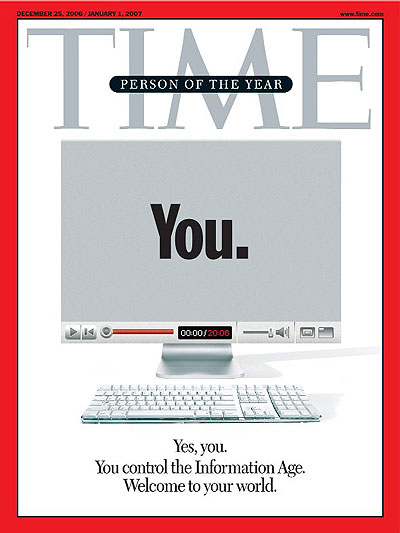
Culture Shock 01.11.07: Why 'You' became Person of the Year

Many in both the "establishment media" and the blogs greeted Time magazine's choice last month of "You" as Person of the Year with jeers and sneers.

Was Time, itself a charter member of the Media Establishment, pandering to its readers? Did Time's editors really think "You" deserving over, say, President Bush, Barak Obama or those nuts in Iran and North Korea? Were Time's editors, like some fortysomething father of three, trying, pathetically, to be hip? What gives?

Then, a few days later, what passes for the Iraqi government hanged Saddam Hussein, making him not only an ex-dictator, but an ex-Saddam. And soon afterward, low-resolution footage of the whole affair — stop, drop and snap, taken with a camera phone — debuted on the wildly popular Web site YouTube.com. By now, it's probably the most-watched snuff film since JFK rode past the grassy knoll.

For once, Time magazine was right. You are the person of 2006.

Saddam's execution was meant to be shrouded in secrecy. But because of the Internet, now everyone can judge for themselves whether it was just or simply revenge for Saddam's decades of oppression. What I think doesn't matter. Thanks to YouTube, you can draw your own conclusion.

This is the breakthrough of the Internet. Until recently, the Internet was much like every other medium that had dominated before it. Like print, radio and television, it was largely one way — people in power talking to you. Now, with the rise of easy-to-use Web sites like Blogger, LiveJournal, MySpace and YouTube, which debuted in 2005, the Internet truly runs in both directions. You can talk back.

You no longer have to know the first thing about computer programming to have your own Web site, filled with your own thoughts, opinions, photographs and videos. Now, there is no gatekeeper, no middleman preventing you from finding an audience. While the big music and movie companies whine about diminishing profits and illegal downloads, amateur bands and filmmakers are posting their own material on MySpace and gaining a following.

The leak of the Saddam video proves that "You" — that is, anyone — can drive a story. But it's not such huge, headline-grabbing stories that, in the end, really matter. No, what matters are the millions of small stories being told by millions of people who now have a way to talk to the entire world.

Compared to biological evolution, cultural evolution occurs in the blink of an eye. Now it will occur even more rapidly. As the average person produces more and more content for the Internet, more and more ideas are subject to its great, electronic feedback loop, which weeds through them like the cyberspace equivalent of natural selection. Charles Darwin meets Bill Gates.

Post a video to YouTube, and viewers can rate it. Write a blog, and you live or die by the number of other sites that link to you. It's the same power Roman emperors wielded in the Coliseum, only dispersed among billions of thumbs and only metaphorically fatal.

Of course, there is still a place for one-way media. We all spend more time consuming content than creating it. But the ratio of consumption to creation is no longer as lopsided as it was.

There is a lot more creativity out there than before. And You are responsible.

Thursday, January 04, 2007

Culture Shock 01.04.07: 'Lio' brings macabre humor to comics pages

If you're a reader of The Daily's comics pages, you've probably already noticed the change. Gone is longtime favorite "FoxTrot," and in its place is newcomer "Lio."

Changes on any newspaper's comics page don't come easy. Every strip has its following — although what some of you see in "Family Circus" I'll never understand. Drop one strip, and the outcry is so intense that you'd think you'd been caught drowning puppies.

But this time, the change was forced upon us when "FoxTrot" cartoonist Bill Amend decided to scale back his workload. He is now drawing only the Sunday strip, which The Daily still carries.

Normally, I'd be extremely upset by all of this. "FoxTrot," along with "Dilbert" and "Mutts," is one of my favorite strips, not counting reruns of "Peanuts." But even I must admit that we and other newspapers that have started carrying "Lio" in place of "FoxTrot" have traded up.

When I first learned about "Lio," I read all of the old strips going back to May 15, when it began syndication. I was amazed. No kidding, "Lio" isn't your typical comic strip.

"Lio" has a surreal, sometimes even macabre sense of humor that owes more to Charles Addams' "Addams Family" cartoons for The New Yorker than to anything currently appearing in the funny pages.

The title character is a little boy and aspiring mad scientist with a menagerie of bizarre pets — including a squid — and a habit of encountering menacing characters, from vampires and extraterrestrials to ants bent on world domination and the kite-eating tree that once menaced Charlie Brown.

Speaking of Charlie Brown, it's also not unusual for Lio to meet other comic-strip characters, or reasonably facsimiles. In one strip, Lio meets a homeless man with a small, stuffed tiger. The man is a thinly disguised Calvin from Bill Watterson's late, lamented strip "Calvin and Hobbes."

And the man has a sign that says, "Retired too early. Please help."

Part of Lio's charm is that he is keenly aware that he is a character in a comic strip. "Lio" is certainly not the first postmodern comic strip, but it is one of the few since "Krazy Kat" to bring a consistently postmodern, absurdist sensibility to daily newspapers.

The man behind "Lio" is Mark Tatulli, who also writes and draws the strip "Heart of the City" and is post-producer for the cable TV shows "Trading Spaces" and "A Wedding Story."

Tatulli, 43, who lives in Philadelphia, describes "Lio" as a pantomime strip with minimal text and seldom any dialogue.

The drawings tell the stories. That means each strip demands more attention than it takes to get the latest iteration of a Garfield-hates-Mondays joke.

With the retirement of Watterson, the demise of Gary Larson's "The Far Side" and the passing of "Peanuts" creator Charles Schultz, some have wondered if there is any life left in the daily comic strip. And, as an industry, daily newspapers have not helped matters, as we've been forced to scale back the space we devote to comics.

But "Lio" gives me hope that the daily comic strip may yet have some life left.

Thursday, December 28, 2006

Culture Shock 12.28.06: James Bond gets real, but Superman returns as a phony

Two icons returned this year, one with renewed relevance, the other creaking under his own pretensions.

Strangely, James Bond, the character who shouldn't work divorced from his Cold War origins, showed new energy. Meanwhile, the supposedly timeless Superman, remained as stiff and lifeless as ever, not so much the Man of Steel as the man of rigor mortis.

Daniel Craig's steely eyed Bond in "Casino Royale" is as close as the movies have come to capturing the ruthless, flawed character of Ian Fleming's novels. The new Bond is lean, mean and rough-hewn. He fits in comfortably with the threats of the 21st century.

The clear divide between East and West, communist and capitalist, is gone. The good guys won, and, apart from Cuba and North Korea, even the communists are capitalists now. The new map is a fractured landscape of terrorists, crime syndicates and rogue states. You have to be nimble to keep your footing, and Craig's Bond shows us that he is — both literally, during the movie's foot-chase sequence, and figuratively, by actually growing as a character.

Superman, however, never grows. Officially, he is the champion of truth, justice and the American way, however vaguely defined. But in practice, he is the heavy-handed enforcer of the status quo and the Establishment. He started as the poster boy for the New Deal and, later, 1950s conformity. In the 1980s, writer/artist Frank Miller realized this and cast Superman as a puppet of a corrupt government in his graphic novel "Batman: The Dark Knight Returns."

This year, as played by Brandon Routh in "Superman Returns," Superman is an uneasy combination of underwear model and savior. Director and co-writer Bryan Singer sees Superman as a divine figure. He especially goes overboard with a scene in which Lex Luthor's henchmen beat the Kryptonite-poisoned Superman nearly to death in the mud. It's all shamelessly reminiscent of Mel Gibson's "Passion of the Christ."

Singer leaves no doubt that he thinks Superman, the strange visitor from another planet, is way better than us mere humans. While Miller distrusts authority and gives us a Superman degraded by his close proximity to it, Singer gives us a morally superior overlord. Miller has faith in humanity, while Singer puts his faith with the gods on Mount Olympus.

After the failures of Iraq and Katrina, Singer's faith in the great leader seems quaint at best and dangerous at worst. Worse still, his Superman is a cipher. You can read into him whatever values you like, but that doesn't mean you'll be right. Superman is like a politician who gives pleasant speeches utterly free of content. He's Barack Obama.

Dressed up as an ennobling figure, the Superman of "Superman Returns" is really a cynical reflection of everything wrong with the world — a pretend savior who can't deliver.

Meanwhile, the James Bond of "Casino Royale" may be a cynical killer, but he is honest about who he is. He is a blunt instrument in a messed-up world — an everyman hero, but cooler. His way of fixing things isn't pretty, but it's better than waiting for Superman to save us.

Thursday, December 21, 2006

Culture Shock 12.21.06: Non-Christian elements of Christmas there from start

'Twas the week before Christmas, Bill O'Reilly in view
Shouting on the TV as his face turns Yuletide hue.
While his Fox pal John Gibson wrote a book just to say,
"There's a 'War on Christmas'! Purchase your copies today!"


OK, I'll stop now. You get the point. But, really, enough with the "war on Christmas" stuff already. With the shopping and the crowds, folks have enough to worry about without opportunistic blowhards making up a controversy.

Putting the name aside for a minute, Christmas has never been just about Christ. Early church fathers set the date for Christmas to coincide with (and co-opt) pre-existing pagan festivals centered on the winter solstice. Pagan elements have been with the holiday ever since, including the venerable Christmas tree. In fact, it was exactly such non-Christian aspects of the holiday that led many Protestants to virtually ignore Christmas until the Victorian era.

If you think Christmas is "too commercial," blame those same Victorians. They started the commercialization of Christmas back in the late 1800s, along with its transformation into a semi-secular holiday of gift giving and family togetherness. It's that commercialization that made Christmas "safe" for Christians who had religious objections to the celebration.

If keeping the Christ in Christmas meant leaving out everything else, then the result wouldn't really be Christmas. Besides, if O'Reilly and Gibson are looking for a fight, someone should tell them they've already lost.

The secular side of Christmas is firmly part of American culture, and it goes deeper than Rudolph, Frosty, saying "Happy Holidays" instead of "Merry Christmas" and bland Christmastime love songs by The Carpenters played ad infinitum.

The secular Christmas won when "A Christmas Story," the 1983 comedy about a boy's quest to get the ultimate present — a Red Ryder BB gun with a compass in the stock and a thing that tells time — replaced "It's a Wonderful Life" as Christmas Day marathon viewing.

"A Christmas Story" is our new seasonal fairy tale. And it's all about presents and commercialism, with a dash of (dysfunctional) family togetherness tossed in for good measure. It doesn't have a manger scene, but it does have a Little Orphan Annie decoder ring.

The movie appeals to Americans because it appeals to the child in us all. Sure, my childhood Christmas is several decades removed from the early 1940s Christmas of Ralphie and his Red Ryder. For me, it was an Atari 2600, but the spirit is the same. We associate particular Christmases with what we got, and that reminds us of where we got it.

Given its diverse origins — Christian, Roman, Germanic, etc. — it's only proper that Christmas has returned to being a near universal celebration. It's observed even in Japan, where it's become strangely associated with romance and dining on KFC.

Christmas is both secular and religious, commercial and spiritual, Christian and pagan. It has something to offer everyone, including a message of "peace on Earth and goodwill toward men." The wording may be Christian, but the sentiment has many sources.

Thursday, December 14, 2006

Culture Shock 12.14.06: 'Star Trek's' 40th birthday flies past at warp speed

Somehow, the year is almost gone. And yet hardly a word has been said about 2006 marking the 40th anniversary of an American institution.

It was in 1966, by way of the 23rd century, that the starship Enterprise set forth on its storied five-year mission. But four decades later, “Star Trek” has entered turbulent seas, or their outer-space equivalent.

For the first time since 1985, “Star Trek” is absent from both TV and movie screens, unless you count reruns. The only “new” Trek to be had is the 1973 animated series, which made its long-awaited debut on DVD last month, and the original series, returned to syndication with new, high-tech special effects in place of the ’60s-vintage models and matte paintings.

While it’s sad to see Trek’s anniversary pass quietly in the night, the Franchise, as it’s become known, clearly needs a rest. Its decline in quality, starting with the final two seasons of “Star Trek: The Next Generation” and reaching rock bottom with “Star Trek: Voyager” and “Enterprise,” made a breather inevitable. Simply put, the creative team in charge of the Franchise at the bitter end had nothing left.

“Star Trek” had gotten away from the original vision of creator Gene Roddenberry and producer Gene L. Coon. And the attempt to recapture some of that frontier spirit during the last season of “Enterprise” couldn’t overcome that show’s dull, backward-looking premise. Prequels, by definition, don’t boldly go where no man has gone before.

The next “Star Trek” film, reportedly planned for 2008, is also rumored to be a prequel. If so, Trek’s keepers haven’t learned their lesson yet.

The original “Star Trek” was inspirational. Literally. You don’t have to look far to find scientists, engineers and astronauts inspired to enter their chosen fields by “Star Trek.”

But who could be inspired by Trek’s recent incarnations? By the time “Enterprise” was canceled, Trek was looking inward, at its own increasingly convoluted past, not outward.

Oddly enough, while “Star Trek” is slowly becoming a parody of itself, many of the people who have long lived in the Franchise’s shadow are finally emerging.

After winning two Emmy Awards for his portrayal of “Boston Legal” attorney Denny Crane, it’s safe to say that William Shatner has found a role to finally rival, if not eclipse, Capt. James T. Kirk. Leonard Nimoy has left behind Mr. Spock and found a new calling as a photographer, mostly photographing nude women, which is nice work if you can get it. Even George Takei, better known as Lt. Sulu, has moved on, recently taking a supporting role on the hit NBC series “Heroes.”

Sure, lots of “Star Trek” fans, too many in fact, will fawn all over anything bearing the Trek logo.

But those of us who really care about Roddenberry’s creation deserve better. And we’re willing to wait for it. No “Star Trek” at all is better than Trek in name only.

Still, the lack of recognition on Trek’s 40th anniversary is almost shameful. You can be sure that George Lucas won’t let 2007 pass without everyone on the planet knowing that it’s the 30th anniversary of “Star Wars.” And, if anything, the “Star Wars” franchise is even more tarnished than the Trek franchise.

What was I just saying about prequels being a bad idea?

Thursday, December 07, 2006

Culture Shock 12.07.06: Science fiction's outsiders find new respectability


There are snooty critics who see it symptomatic of civilization's decline. But the American literary canon is finally expanding to encompass some of our most influential, yet neglected, writers.

The Associated Press reported last week that the Library of America will release in 2007 a volume devoted to science-fiction writer Philip K. Dick. Although there is no shortage of Dick's stories in print, this is significant news because the Library of America is the closest thing the U.S. has to an official literary gatekeeper. If the L of A publishes your work, you are a Significant Author. To be part of the Library of America is to be one with Faulkner, Fitzgerald, Hawthorne and Melville.

"Philip K. Dick: Four Novels of the 1960s" is scheduled for publication in June. It will include the novels "The Man in the High Castle," "The Three Stigmata of Palmer Eldritch," "Ubik" and "Do Androids Dream of Electric Sheep?" The last of those was made into the 1982 Harrison Ford movie "Blade Runner."

Jonathan Lethem is editing the volume. Lethem, author of "Motherless Brooklyn" and "The Fortress of Solitude," is considered a "literary" author, although he actually has written quite a bit of genre fiction, including the futuristic "Gun, with Occasional Music." But although Lethem sometimes writes science fiction, his books aren't marketed as science fiction. He isn't confined to the ghetto as was Dick, who died in 1982.

And he's happy to do his part to assist Dick's escape. In an interview with the blog The Elegant Variation, Lethem said, "I'm helping preside over the utter and irreversible canonization of one of my (formerly outsider) heroes ..."

But Dick's ascendance to the literati firmament wouldn't mean much if it were merely an isolated incident. It isn't.

Last year, the Library of America elevated an even more unfairly maligned and neglected figure of genre fiction: H.P. Lovecraft. And it was the positive response to "Lovecraft: Tales" that helped spawn the Dick collection, according Max Rudin, Library of America publisher, in an interview with the AP.

Lovecraft is America's most important horror writer since Edgar Allan Poe, although, like Poe, he seems to have earned greater respect in France, for whatever reason.

The works of science fiction/fantasy writers Ray Bradbury and Ursula K. Le Guin could be the subject of future L of A volumes, Rudin said.

Genre writers are at last getting their due, just three years after the National Book Foundation controversially gave Stephen King its Distinguished Contribution to American Letters Award and sent the snobs into apoplectic fits.

"But giving an award like this to a guy like me suggests that in the future things don't have to be the way they've always been. Bridges can be built between the so-called popular fiction and the so-called literary fiction," King said in his acceptance speech.

It's a two-way street. When Philip Roth, an undeniable member of the Literary Establishment, delves into science fiction with an alternate history novel like "The Plot Against America," it becomes far harder for critics to ignore those who've plowed the fields of SF for decades. Then the critics might learn that Roth's plot is such a cliche in SF circles that even most hacks wouldn't touch it without giving it some new twist.

If mainstream critics are forced to read unapologetic science fiction, horror and fantasy, there's no telling who will be admitted to the canon of respectable literature next. I suggest Harlan Ellison.