Showing posts with label football. Show all posts

Thursday, July 03, 2014

Culture Shock 07.03.14: America still ambivalent about soccer

I harbor no illusions. Every four years, the World Cup rolls around. Americans suddenly show a modicum of interest in the world's most popular sport. And people wonder if this, at long last, is the breakthrough year for soccer in the U.S. of A.

Then Team USA gets knocked out of the tournament, and everything goes back to the way it was.

Well, almost. Soccer emerges ever so slightly more popular than it was, getting a tiny boost in its slow, yet inexorable climb. It's not a lot, but it's something. And a few more kids who would have gone out for football or basketball try soccer instead. Critical mass is just around the corner.

Still, if ever there were a World Cup to ignite Americans' passion for the sport, it's this one. The U.S. team survived the "group of death" only to lose a heartbreaker to Belgium despite goalkeeper Tim Howard's heroics. But scoring is up and even the draws have been exciting. Normally there is nothing worse than a game decided by a tie-breaking penalty shootout. But in the first match of the knockout round, Brazil and Chile managed to make even that outcome compelling.

This World Cup also gives us heroes and villains. Everyone loves Argentina's reserved Lionel Messi. Everyone hates Portugal's prima donna Cristiano Ronaldo. Everyone just shakes their heads at Uruguay’s serial biter Luis Suarez. It's almost like professional wrestling, except not scripted, although there's just enough dodgy officiating to make one wonder. (Thanks, FIFA!)

Team USA is led by Clint Dempsey, who goes by the nickname Captain America. Meanwhile, host team Brazil has a Hulk, aka Givanildo Vieira de Souza. Somehow Disney, which owns both ESPN and Marvel Comics, dropped the ball on this marketing tie-in opportunity. But it's just one more bit of flourish for the fans. (Hulk's goal disallowed on a bogus hand ball? Hulk smash!)

It's all much too much for America's steadfast anti-soccer faction, which views soccer as foreign, slightly sinister and undoubtedly a threat to American Exceptionalism.

American Exceptionalism has always been something of a myth. Most of the things that supposedly make America unique were invented elsewhere. Capitalism? Representative government? Individualism? Sorry, but the English, Scots and Dutch all got there first. We invented jazz, but only the Europeans and the Japanese ever appreciated it. But soccer apathy? That does set us apart.

For the soccer fan in America, that apathy is a mixed bag. If you want to follow top-notch soccer, Major League Soccer isn't there yet. Following the best of the best means following the English Premier League.

England's national team may be a source of constant disappointment, but the Premier League is anything but, largely because its teams are loaded with foreigners. If you're watching the World Cup, you've seen them. Suarez may play for Uruguay's national team, but he plays his club ball for Liverpool, or he will as soon as he completes his four-month suspension.

I upgraded my cable mainly so I can watch Premier League matches — specifically Manchester City — on NBCSN. This is not an inexpensive habit. You can't count on the local sports bar's telly being tuned to soccer, except during the World Cup. The rest of the time, you have better luck finding soccer on TV at a Mexican restaurant, and then it's likely a Spanish-language broadcast. (Unfortunately, I studied German rather than Spanish in school. Not one of my wiser decisions, all said. Dummkopf!)

There is, however, a sunny side to this. American soccer apathy means you can escape soccer when you want. One might complain of "too much" World Cup hype, but that's one month every four years. Try escaping college football in America, to say nothing of in Alabama. It's impossible. It's all some people talk about. And while I'm not a mental health professional, I am worried about some of you. If your vehicle has more than two bumper stickers proclaiming your preferred college football team, you probably have too much of your self esteem wrapped up in the team's success.

But that's just one layman's assessment. Regardless, I've no delusions about soccer's place in America's sportsball pecking order. But where it sits isn't all bad.

Thursday, August 25, 2011

Culture Shock 08.25.11: Discovering the uncanny truth about Canada


Let's get ready to fumble!

Even as football season begins in earnest tonight with the start of high school football in Alabama, to be joined by college football next week and the NFL the week after that, there's one place where they've been playing football all summer.

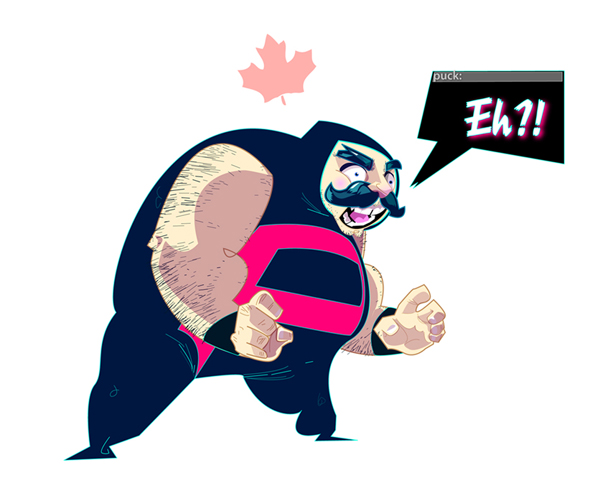
The Great White North. America's Hat. Canada.

Most Americans think of the Canadian Football League — when they think of it at all, which isn't often — as a kind of purgatory, to which players who can't hack it in the NFL are sentenced for an indeterminate time, and from whence only a lucky few (namely Doug Flutie) ever return.

Briefly, during an ill-fated expansion attempt, there was a CFL team in Birmingham. But it folded because Alabama is already home to two semi-professional teams and doesn't need a third.

Currently, CFL games air in the U.S. on NFL Network, which could help the league's profile here. Or not.

You see, I've watched several CFL games over the past few weeks, and I've reached a conclusion: Canadian football is creepy.

The CFL is a lot like U.S. football. After all, the U.S. and Canada are the only countries on Earth where "football" doesn't mean "soccer." So, we have that in common.

But there are slight yet unmistakable differences: the goal posts at the front of the end zones instead of at the back, the 110-yard fields with the C-line in the center, teams having only three downs (not four) to make a first down.

I mean, who puts goal posts at the goal line where players can run into them?

Watching the CFL, I was struck by how odd these small changes made the game. It was weird. Then I realized I'd had this feeling before.

I was watching an ABC cop show called "Rookie Blue." At first, it seemed like an ordinary police drama, but I soon noticed there was something different. The police cars and the uniforms weren't quite right. I felt uneasy. Then it hit me: "Rookie Blue" is actually Canadian.

Between "Rookie Blue" and the CFL, I had an epiphany. Canada is America's uncanny valley.

Think of a human being. Next, think of a cartoon character, like Elmer Fudd. Now think of an almost-human CGI character, like the Tom Hanks clones in "The Polar Express." The Hanks clones exist in the middle, between the two extremes of reality and unreality. They look almost human, but not quite, and their almost-but-not-quite appearance makes them creepy. They're too plastic, too artificial. They scare small children.

They fall into what scientists call "the uncanny valley."

For many Americans, Canada is like that. Sorry, Canada, but that's the truth. And that's coming from an American who can name two, maybe three Canadian prime ministers.

For someone from the U.S., I'm relatively Canada-savvy. One of my favorite comic books growing up was "Alpha Fight," which is about a team of Canadian superheroes. Later, I learned most of the characters were broad, possibly even insulting stereotypes. But, hey, it's the thought that counts.

Despite that, I get weirded out by how Canadians are so like us — more so, I suspect, than many Canadians would care to admit — and yet so different. It's the uncanny valley, like Angelina Jolie in "Beowulf," where you're attracted to her CGI double even as you're dimly aware it's a CGI double.

Yet I doubt Canadians feel the same unease about us. Roughly 90 percent of Canadians live within about 100 miles of the U.S. border.

Whether they like it or not, for better or worse, they're are a lot more familiar with us than most of us are with them.

And that, Canada, is why Americans act so strange whenever we come to visit. But we do appreciate you, even if we don't say so.

Who else could we pretend to be when vacationing in countries where everyone hates us?

Wednesday, November 26, 2008

Auburn and Alabama fans are driven by tribal instinct

If you think we’ve come a long way from our primitive ancestors, look around at your neighbors this weekend, and you’ll likely see we haven’t evolved all that much.

In fact, you may only have to look in a mirror.

A significant proportion of Alabamians will be decked out in tribal colors — either orange and blue for Auburn University, or crimson and white for The University of Alabama. But the odd thing is that most people wearing those colors in anticipation of the annual Auburn/Alabama football game didn’t attend either university.

It doesn’t end there. Some members of each tribe turn entire rooms of their homes into shrines filled with football memorabilia. They dress the family dogs in team sweaters. They walk down the wedding aisle to the tune of their school’s fight song. They name their children after dead coaches.

Making fun of such excess is easy. Actually, I encourage it. But that extreme behavior is, in a way, only natural. In fact, it has roots in 200,000 years of human pre-history.

Our earliest human ancestors lived in the African savanna and survived by hunting and gathering. The rule of the day was eat or be eaten. In such an unforgiving environment, cooperation within a tribe was a necessity.

Every living being, humans included, is a complex machine with one biological purpose — to spread its genetic material. “Be fruitful and multiply” isn’t just a Biblical commandment. It is encoded in our DNA.

Members of hunter-gatherer societies best fulfilled their genetic imperative by cooperating with the people they saw every day, mostly close relations. That’s how tribal bonds formed, and it’s why, even today, people have an enormous capacity for social cooperation. Evolutionary biologists call it “reciprocal altruism,” but everyone else calls it “you scratch my back, and I’ll scratch yours.” (In fact, our chimpanzee cousins practice this literally when they groom each other.) Our brains are wired for it because it’s a powerful survival mechanism, and thus favored by natural selection.

But there is a downside to our mental wiring. While it encourages cooperation within a tribe, it often leads to conflict with other tribes, especially if those other tribes are competing for the same resources. We are “us,” and they are “them.”

Down through the centuries, that tribal instinct had led to racism, ethnic hatred, religious conflict and, on a larger scale, wars between nations fighting to control land, resources and wealth.

Fortunately, human societies evolve far more quickly than human biology does. So, we’ve come up with ways to close the distance between us and them. The most successful is trade. Frederic Bastiat, a 19th century French economist, said, “When goods don’t cross borders, armies will.” Today, large-scale trade between nations is the norm, not the exception. The more trade there is between any two given countries, the less likely those countries will end up at war with one another. As a result, the number of wars going on at any particular time has dropped steadily since the end of the Cold War.

Within nations, individuals are also interconnected by trade. We all do business with each other, and most of our old tribal divisions have broken down or substantially weakened. But we still have that tribal instinct, which now expresses itself, usually, in more peaceful ways — like identifying with collegiate and professional sports teams. We have rituals, like tailgating, that we share with fellow tribesmen, and we compete with other tribes by participating in office betting pools.

We’re driven to join tribes, which is why people who never attended Auburn or Alabama still choose sides. And all tribes seek to grow, which is why natives often pressure newcomers from out of state to pick a team.

You can join a tribe even if you don’t care about sports. For better or worse, tribes form around everything from TV shows (Trekkies) to rock bands (Deadheads) to political candidates (Obamaniacs).

So, when you’re putting on your war paint for the big game Saturday, remember that you’re part of a tradition that dates to the Stone Age. And if your team loses, just tell yourself that football is still better than hunting zebras.