Showing posts with label internet. Show all posts

Thursday, July 21, 2011

Culture Shock 07.21.11: No, the Internet is not making you stupid

Google the question "Is Google making us stupid?" and you'll get roughly 640,000 results.

Like every new technology, the Internet is going through that phase when it gets the blame for everything wrong with the world.

The Internet exploded into the mainstream in the mid-1990s, so it's been a very long phase. But 15 or so years is nothing. Fifty years after Newton N. Minow, then-chairman of the Federal Communications Commission, called television a "vast wasteland," TV still takes heat for all sorts of societal ills, from youth violence (even though youth violence has been steadily going down since the 1970s) to childhood obesity (which you could easily blame on any sedentary activity, like reading a book).

The claim that the Internet is making us stupid got a level-up this past week after publication of a study showing that the Internet is actually changing how we think and remember things.

Now, as it happens, the authors of the study said, explicitly, that their findings did not — I repeat, not — mean the Internet is making us stupid.

"I don't think Google is making us stupid — we're just changing the way that we're remembering things," lead author Betsy Sparrow of Columbia University told the BBC. "If you can find stuff online even while you're walking down the street these days, then the skill to have, the thing to remember, is where to go to find the information."

Basically, our brains are getting better at knowing where and how to find stuff, but at the expense of just remembering stuff, and that's because we're unconsciously training, and rewiring, our brains to work that way by how we use the Internet.

For some people, this is a self-evidently bad thing.

Yet if so, why stop there? The Internet isn't the first technology to alter the workings of our brains.

Centuries ago, our ancestors had fantastic memories that put ours, even pre-Internet, to shame. Bards and poets in the ancient Greek world could recite, from memory, epic tales of gods and heroes that, when written down today, run on for hundreds of pages. True, they used repeating lines and other mnemonic tricks to keep everything straight, but they really did have memories built for recalling a lot of information.

If behavior can rewire the human brain, then that's exactly what you'd expect, because the Greeks who lived in the dark ages between the fall of the Bronze Age city states and the rise of classical Athens, were, by and large, illiterate. This is when bards created the oral tradition of epic poetry that would eventually find its way into print as "The Iliad" and "The Odyssey."

The finished works we have today, attributed to the blind poet Homer, may not have been written down until the classical period, centuries after their composition began. Before that, these unwritten stories were passed down by memory, bard to bard, generation to generation.

Arguably the greatest, most influential works of Western literature were composed by illiterates, who relied not on writing but on their remarkable recall.

So, if you're really worried about technology robbing people of their ability to remember things, start with writing. That's where the trouble all began.

Thursday, June 09, 2011

Culture Shock 06.09.11: Sexting mishaps not just for teens

Not since the late Sen. Ted Stevens described the Internet as "a series of tubes," has a sitting congressman's misunderstanding of how the Internet works provided comedians — and lowly columnists like me — with so much material.

Oh, Anthony Weiner, where have you been all my life?

It's one thing for a politician to get caught up in an embarrassing sex scandal. It can even be a good career move. Exhibit A: former New York Gov. Eliot Spitzer. As attorney general, he crusaded against prostitution. Four years later, he resigned the governorship after he was unmasked as Client 9 in a high-profile prostitution sting.

Did that keep Spitzer down? No way. You can watch him weeknights on CNN, which has got to be a better gig than dealing with the New York State Assembly day in, day out, especially now that he no longer has to share his time slot with former co-host Kathleen Parker.

But it's another thing to get caught in a sex scandal usually associated with teenagers.

That's just what Rep. Weiner has done.

He denied it to the bitter end. He now says it was a misguided joke.

But the fact is, Rep. Weiner's accidental public tweeting of a crotch shot of his own crotch, now public for all to see, is just the sort of thing adults have been warning kids about ever since cellphone cameras made it easy for teens to take their own — how to put it? — "self-portraits" and share them with friends.

You never know, for example, when a girlfriend might turn on you. But it'll probably happen after you cheat on her with her best friend. And then the ex will send that compromising picture of you not wearing pants to all of her friends, who now also hate you because you're a two-timing jerk. And the next thing you know, pictures of your junk are all over campus.

(No, this is not a personal story. We didn't have cellphones when I was in school. And the only embarrassing pictures of me in the public domain are the ones my "friends" have posted on Facebook, in which I always seem to be holding a bottle of PBR. People could easily get the wrong idea. They might think I'm an alcoholic or, worse still, a hipster.)

So, basically, Rep. Weiner didn't quite know how Twitter worked, and now what has been seen can't be unseen.

As it turns out, a couple of years ago, when psychologists and other people with too much time on their hands were fretting about teenagers ruining their college and job prospects by "sexting" naked pictures of themselves to each other, they should have been worried about the nation's lawmakers doing the same thing.

A hypocrisy-laden prostitution scandal is an adult scandal. That's what we expect of the alleged adults we elect to office. But a sexting scandal is a juvenile scandal.

How do you explain that to the wife?

UPDATE: Last week, I complained that DC Comics' forthcoming revamp of all of its superhero titles would probably mean the end of one of the company's few consistently good books, Grant Morrison's "Batman, Inc."

This week, DC announced that "Batman, Inc." will return next year. How this fits with DC's stated plans I can't guess, but I'll take all the good news I can.

Thursday, May 26, 2011

Culture Shock 05.26.11: Tamed Internet still has bizarre territories

In the early days of the World Wide Web, before anyone really knew what to do with it, people would create Web pages for just about anything.

It was easy. Do-it-yourself websites were all the rage. And strange, bizarre, yet sometimes wonderful pages sprouted up all over the Internet, usually on free sites like the late, lamented Geocities, where garishly bad Web design became something of an art form and half of the pages always said they were "under construction," no matter how old they were.

These pages often were devoted to celebrities, obscure television shows, childhood toys and the like.

Some are still around, but they've grown up and gotten professional.

Some of the rest have migrated to social networks. For instance, there's a Facebook page devoted to Burger Chef, a hamburger chain that all-but faded from existence in the mid-1980s. Then there's another Facebook page just for vintage newspaper advertisements for drive-in movies. And that's just to name two that conform to my own strange and bizarre interests.

Still, even outside of Facebook, you will sometimes run across a site that's devoted to something so odd it seems like it fell through a time warp from the Web's early days — except it's better designed, because nothing, and I mean nothing, not even MySpace, will ever be as poorly designed as those Geocities pages were. Bless their hearts.

Recently, I've stumbled upon three websites so specific in their subject matter you really have to wonder about the people who created them.

The first is House's Canes at http://www.earthimmigrant.net/housescanes/home.html.

It is, as you might guess, devoted to all of the various canes TV's most acerbic doctor, Gregory House, has used over the course of seven seasons of "House."
This site is full of stats. It tells you when a particular cane first appeared, how many episodes it appeared in, and, if known, what happened to it.

My favorite is the Walnut Derby cane, which lasted 20 episodes until Wilson sawed it in half — season 2, episode 16 — to get revenge for one of House's pranks. I even own a replica.

Currently, House is using a Rosewood Tourist cane, which he's had since season 6, episode 4, making it the longest-serving cane so far.

Yet this is the least bizarre of the three websites in question.

Next on the list is The Cosby Sweater Project at http://thecosbysweaterproject.tumblr.com.

Again, as the name suggests, this site is obsessed with the many sweaters Bill Cosby and the other cast members wore on Cosby's venerable 1980s sitcom "The Cosby Show."

That's all it is. Seriously.

But at least Cosby's sweaters were kind of a running joke at the time.

Our final website's obsession, however, is so far out there not even the truth is out there.

And that's the segue into Fox Mulder's Wristwatch, found at http://foxmulderswristwatch.com and billed as "The Internet's most comprehensive examination of the watches worn by Fox Mulder on TV's ‘The X-Files'."

Indeed.

This is my new favorite website ever. Fox Mulder's Wristwatch wins the award for the most random topic ever to have a website devoted to it.

(Don't try to top it. You'll just be wrong.) And in case you're wondering, there are at least 12 different models documented so far, including everything from an Omega Quartz De Ville Prestige to a Casio digital, meaning, at some point, Mulder thought digital watches were a pretty neat idea.

This was the reason the Internet was invented. It's not about national security or commerce or education or even naughty pictures. (OK, it's partly about naughty pictures.) It's about the freedom of someone to share with the entire world an obsession with a TV character's timepieces.

Thursday, December 04, 2008

The Rickroll is dead; long live the Rickroll

I hereby declare the end of the Rickroll.

The Internet prank, which involves a seemingly cool Web link that goes instead to a video of ’80s pop star Rick Astley singing “Never Gonna Give You Up,” is passé now that the ultimate Rickroll has been pulled.

During NBC’s annual broadcast of the Macy’s Thanksgiving Day Parade last week, Astley got the last laugh. He appeared unexpectedly on the Cartoon Network float and lip-synced his most infamous hit single.

In an instant, Astley had Rickrolled more people than any online prankster could ever dream of. No one can top that, so it’s time to stop trying.

The Rickroll is over. Now we need a replacement.

Fortunately, the 1980s is a treasure trove of ghastly songs that soared to the top of the pop charts. I blame cocaine abuse.

“The Girl Is Mine.” Before they tangled over the rights to the Beatles catalog, Michael Jackson and Paul McCartney recorded two duets. The first, and worst, was 1982’s “The Girl Is Mine” from Jackson’s “Thriller.” As the first single off the most popular album of all time, “The Girl Is Mine” was everywhere. Now that the drugs have worn off, however, we can recognize what an unbearably hokey song it is.

“Ebony and Ivory.” Earlier that year, McCartney teamed up with Stevie Wonder for another duet, “Ebony and Ivory.” The song reached No. 1 on both the U.S. and British pop charts, proving that bad taste doesn’t respect geographic boundaries. As trite as it is awful, “Ebony and Ivory” uses the black and ivory keys of a piano as a metaphor for racial harmony. And in case you don’t get the message, McCartney and Wonder’s harmonizing is also a metaphor for racial harmony. Listening to the song today is like having a piano dropped on your head.

Let this be a lesson to everyone: If McCartney wants to record a duet with you, just say no.

“Ice Ice Baby.” This song was Vanilla Ice’s contribution to bad music, giving the world insightful lyrics like “Will it ever stop? Yo, I don't know/Turn off the lights, and I'll glow.” Vanilla Ice, aka Robert Matthew Van Winkle, almost won a Grammy for this atrocity. However, he lost to ...

“U Can’t Touch This.” Yes, there was a time when people thought MC Hammer was cool. He was so cool, in fact, that you couldn’t touch him — presumably because you’d get frostbite if you did. So, he penned the song “U Can’t Touch This.”

Most recently, the man otherwise known as Stanley Kirk Burrell was getting in touch with his spiritual side as the host of a show on the Trinity Broadcasting Network. But whether or not his soul is immortal, his song is — like a vampire sucking the life out of anyone it encounters.

“Who Can It Be Now?” I will admit a nostalgic fondness for Men at Work’s other hit, “Down Under,” a reggae-tinged anthem to the manly virtues and poor dietary habits of Australians. But “Who Can It Be Now?” hasn’t aged well. Neither has …

“Somebody’s Watching Me.” This is the only hit by Rockwell, son of Motown Records founder Berry Gordy. Both “Who Can It Be Now?” and “Somebody’s Watching Me” deal with paranoia and have lyrics such as “Is it the man come to take me away?/Why do they follow me?” and “When I’m in the shower/I’m afraid to wash my hair/’Cause I might open my eyes/And find someone standing there.”

Why were these songs so popular in the ’80s? Again, I fault cocaine, which is said to cause paranoid delusions. These were songs cokeheads could relate to.

But probably the best potential successor to “Never Gonna Give You Up” is …

“Girl You Know It’s True.” Milli Vanilli won a Grammy for Best New Artist after releasing this earnestly lame single in 1989. But the duo had to give back their award because someone else actually recorded the vocals. The truth, however, is this song is bad no matter who sings it.

The ’80s gave us so much terrible music that I could go on for hours. But it takes a truly heartfelt, unironic and irredeemably shallow song to replace “Never Gonna Give You Up.” It set the standard.

Thursday, April 17, 2008

Things to do on the Internet when you’re dead

Note: The following column contains Internet language. It may be unintelligible to people over 30. Teenage translation is suggested.

I don’t have statistics to prove it, but I’m reasonably sure that the second most common use of the Internet, after looking up naked pictures of celebrities, is wasting time.
But there are more and less productive ways of wasting time while surfing the Internet. So, here are some of my favorites, in no particular order.

Lolcats. Once upon a time, there was a photo of a forlorn kitty who asked a simple, if grammatically suspect, question: “I can has cheezburger?” Did the cat ever get a cheeseburger? Who knows? It doesn’t matter. What matters is what followed. From that one photo and its semiliterate plea grew a phenomenon.

Now, the lolcats — cats who will make you “laugh out loud” — are everywhere. They’re in cars, buckets, washing machines and, yes, even in ceilings. Some are happy, others sad. They can’t quite grasp the English language. They made you a cookie, but then eated(cq) it. And most have simply had enough of you silly humans.

One Web site collects them all: icanhascheezburger.com. At last count, the site was up to more than 240 pages of pictures of cats, and a few others animals, too, in funny situations with funnier captions.

But just Google “lolcat,” and you’ll find them everywhere.

The lolcats have become so popular that the dogs have become jealous. So, now the loldogs have their own Web site, ihasahotdog.com. But it’s not as good as the lolcats’ site, because LOLCATS > LOLDOGS LOL!!!

(Author’s note: All dog lovers offended by the idea that cats are better than dogs, please e-mail your complaints to Scott Morris, managing editor and cat hater, at smorris@decaturdaily.com. K? THX.)

The Rickroll. There you are, minding your own business, when a friend e-mails you a link. You click it. Then, you realize your mistake, but it’s too late. You’ve been subjected to totally unexpected Rick Astley. Now you’re going to have his stupid song stuck in your head for the rest of the day. You’ve been Rickrolled.

Astley is the freckle-faced poster boy for 1980s musical mediocrity, as exemplified by his biggest hit, “Never Gonna Give You Up.” He was everything that was wrong with pop music during the decade of Ronald Reagan and “Family Ties.” He couldn’t even succeed as a one-hit wonder, because he actually had a second hit, “Together Forever.” There is some minimal amount of coolness that comes with being a one-hit wonder. But there is no such thing as a two-hit wonder. Having two hit singles before sliding into obscurity just makes you lame.

That’s what makes the Rickroll such a devious Internet prank. Well, that and the fact that Astley’s lyrics make him sound like a potentially dangerous stalker.

Last.fm. First there was Friendster. Then MySpace. Then Facebook. But there is one social networking Web site that lets you truly appreciate how terrible your friends’ taste in music is — Last.fm.

In addition to letting you listen to a lot of music online and free of charge, Last.fm can monitor the MP3s you play on your computer or iPod and match you with others who have similar musical tastes. You can also see what music your friends are listening to, and if it’s good, you can then e-mail your so-called friends and ask them why they haven’t already burned you a CD. (Editor’s note: The Decatur Daily’s staff and management do not condone music piracy.)

Of course, you’re more likely to discover that your friends, like most Last.fm users, have rotten musical tastes. And in that case, you can mock them for it. I mean, really, Coldplay? Coldplay??? I thought I knew you people.

Thursday, November 22, 2007

Forget the writers; how will the strike affect me?

If you’re a TV junkie, one thing you can be thankful for is that Hollywood’s writers and producers are due back at the bargaining table Monday.

That doesn’t guarantee an end to the writers’ strike, which already threatens to end the fall TV season at its halfway point, but the smart money in Hollywood seems to be on both sides reaching an agreement sooner rather than later. That’s good news for those of us who don’t want to see 100-plus channels of unscripted “reality television” or rejected pilots for the next six months.

The last Writers Guild of America strike was in 1988 and lasted 22 weeks.

As usual, the strike comes down to money. The producers have it, and the writers want more of it. Specifically, the writers want to be paid every time someone downloads a movie or TV episode from the Internet. That’s in addition to the upfront money they get from writing the scripts in the first place.

I can see where the writers are coming from. Every episode of “House” I’ve watched this season is one I’ve downloaded from Amazon.com, where they cost $1.99 each. Screenwriters might earn a fraction of a cent from each download, but with enough downloads, it could add up fast.

Still, I refuse to pick sides. Both the writers and the producers are looking out for their own interests, and there’s no moral high ground in that. But that isn’t stopping the writers from painting themselves as the “little guy” and producers as a bunch of evil, money-grubbing fat cats. After all, that’s a Hollywood script that almost writes itself.

The WGA didn’t do its image any favors by picking on Ellen Degeneres, who has refused to shut down her daytime talk show because she has this funny little thing called a contract — which promises her affiliates new episodes, not reruns. Heaven forbid that Ellen look out for herself and her employees by fulfilling her contractual obligations.

If you really want to talk about the “little guy,” he’s the fellow who owns a catering business that’s lost money every day since the strike began. When Hollywood shuts down, the first people to feel it are those who work in the service industries. You can’t sell lattes to writers who are walking picket lines instead banging away at laptops in your cafe.

But I’m not really interested in the little guys, either. Like the writers and producers, I’m looking out for myself. And what I want is a full season of “C.S.I.,” not a schedule full of “American Idol” and “Survivor” clones. Maybe I should make a sign and pace back and forth in front of some screenwriter’s house.

The WGA says it’s looking at the long run, when Internet downloads will become the main way people watch TV and movies. I say I’m looking at the long run, too. If the strike continues, how long will I have to wait for my favorite shows to hit DVD? And when the new season sets finally arrive, will they contain only half the usual number of episodes? These are important questions affecting my TV enjoyment well into 2008.

Probably the only good thing about the strike is its timing. We weren’t going to see too many new scripted dramas and comedies over the next month and a half, anyway. That’s because it’s the Christmas season, when TV programmers’ thoughts turn to endless repeats of classic and not-so-classic holiday fare. Never mind the 30 or so college football bowl games on TV, too.

If nothing else, it’s as good a time as any to check out what’s on BBC America. At least the TV writers over in the land of Shakespeare aren’t on strike.

Thursday, October 18, 2007

Internet radio is thriving now, but for how long?

I have a new addiction: Soma.

No, not the fictional drug of Aldous Huxley’s “Brave New World,” but SomaFM, an Internet-based “radio” station broadcasting commercial-free music from a garage in San Francisco.

SomaFM emerged in 1999 from one of those most noble of institutions: a pirate radio station. Not a “Pump Up the Volume”-style pirate radio station, but a station serving that year’s Burning Man festival.

Burning Man is an annual celebration of arts and anarchy held in Nevada’s Black Rock Desert. For more about it, see Brian Doherty’s definitive and entertaining book, “This Is Burning Man.”

Burning Man, however, was only the beginning. In February 2000, Rusty Hodge, SomaFM’s founder, launched a Web site to stream his station via the Internet to the entire world. SomaFM is now one of the largest Internet-only radio stations, broadcasting more than 3 million “listener hours” a month and reaching about 8,000 listeners on average at any given time.

SomaFM’s playlists are far removed from typical top 40 radio. The 11 separate channels at SomaFM.com offer mostly a mix of electronic, ambient, trance and trip-hop music — the sort of stuff often referred to as “New Age,” not that much of it has anything to do with the eclectic group of religions often lumped under that name.

It’s music most people usually can’t hear over the air, apart from public radio shows like “Echoes” and “Hearts of Space.”

Hodge and SomaFM quickly became an Internet success story, not in terms of profits because there weren’t any, but in terms of Web hits, word of mouth (or e-mail) and satisfied listeners who had gone unserved by the likes of Clear Channel.

If SomaFM were the subject of a VH1 “Behind the Music” episode, this would be the point in our story where everything goes wrong. As it happens, everything does go wrong.

In 1998, Congress passed one of the most poorly conceived pieces of legislation of the past decade: the Digital Millennium Copyright Act. And in 2002, using the DMCA as a sledgehammer, the Recording Industry Association of America went after Internet radio stations for millions of dollars in royalties.

“I was looking at owing the RIAA an obscene amount of money, like $100,000,” Hodge told the San Francisco Chronicle in a 2004 interview, “so I chickened out at the time and took the station off the air.”

Internet broadcasters fought back, and Hodge testified before the U.S. Senate Committee on the Judiciary. Eventually, the RIAA relented and settled on a lower royalty fee, which for SomaFM is $2,000 a year, funded by listener donations.

As a result, SomaFM is back. But the legal problems, unfortunately, continue.

On May 1, the federal Copyright Royalty Board raised the fees for Internet broadcasting, making Web broadcasters responsible for royalties that over-the-air broadcasters don’t have to pay. A bill in the U.S. House to overturn the CRB’s decision, H.R. 2060, has more than 140 co-sponsors, but so far it has gone nowhere.

The duplicity here simply reeks. Congress is filled with demagogues who routinely rail against the broadcasting conglomerates like Clear Channel and Cumulus Media, the two largest owners of traditional radio stations. But when it comes to fostering competition where it really matters — the Internet — Congress stands with the big broadcasters and major music labels.

Of course, traditional broadcasters are dependent on government licenses in order to transmit over the “public” airwaves, so they, unlike Internet broadcasters, are reliable donors at election time.

But for now, Internet radio stations like SomaFM are still going. So, try them out before it’s too late. And maybe leave a few bucks in the tip jar while you’re at it.

Thursday, January 11, 2007

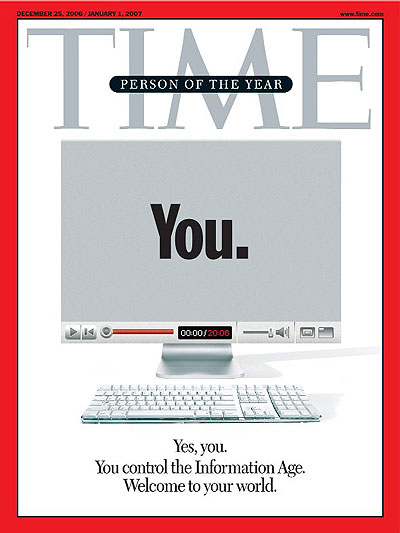
Culture Shock 01.11.07: Why 'You' became Person of the Year

Many in both the "establishment media" and the blogs greeted Time magazine's choice last month of "You" as Person of the Year with jeers and sneers.

Was Time, itself a charter member of the Media Establishment, pandering to its readers? Did Time's editors really think "You" deserving over, say, President Bush, Barak Obama or those nuts in Iran and North Korea? Were Time's editors, like some fortysomething father of three, trying, pathetically, to be hip? What gives?

Then, a few days later, what passes for the Iraqi government hanged Saddam Hussein, making him not only an ex-dictator, but an ex-Saddam. And soon afterward, low-resolution footage of the whole affair — stop, drop and snap, taken with a camera phone — debuted on the wildly popular Web site YouTube.com. By now, it's probably the most-watched snuff film since JFK rode past the grassy knoll.

For once, Time magazine was right. You are the person of 2006.

Saddam's execution was meant to be shrouded in secrecy. But because of the Internet, now everyone can judge for themselves whether it was just or simply revenge for Saddam's decades of oppression. What I think doesn't matter. Thanks to YouTube, you can draw your own conclusion.

This is the breakthrough of the Internet. Until recently, the Internet was much like every other medium that had dominated before it. Like print, radio and television, it was largely one way — people in power talking to you. Now, with the rise of easy-to-use Web sites like Blogger, LiveJournal, MySpace and YouTube, which debuted in 2005, the Internet truly runs in both directions. You can talk back.

You no longer have to know the first thing about computer programming to have your own Web site, filled with your own thoughts, opinions, photographs and videos. Now, there is no gatekeeper, no middleman preventing you from finding an audience. While the big music and movie companies whine about diminishing profits and illegal downloads, amateur bands and filmmakers are posting their own material on MySpace and gaining a following.

The leak of the Saddam video proves that "You" — that is, anyone — can drive a story. But it's not such huge, headline-grabbing stories that, in the end, really matter. No, what matters are the millions of small stories being told by millions of people who now have a way to talk to the entire world.

Compared to biological evolution, cultural evolution occurs in the blink of an eye. Now it will occur even more rapidly. As the average person produces more and more content for the Internet, more and more ideas are subject to its great, electronic feedback loop, which weeds through them like the cyberspace equivalent of natural selection. Charles Darwin meets Bill Gates.

Post a video to YouTube, and viewers can rate it. Write a blog, and you live or die by the number of other sites that link to you. It's the same power Roman emperors wielded in the Coliseum, only dispersed among billions of thumbs and only metaphorically fatal.

Of course, there is still a place for one-way media. We all spend more time consuming content than creating it. But the ratio of consumption to creation is no longer as lopsided as it was.

There is a lot more creativity out there than before. And You are responsible.