If you think you really own the songs you purchase and download from digital retailers like iTunes, think again.
The same goes for movies and episodes of your favorite television shows.
When you buy a compact disc or DVD, you can take it with you wherever you go, let friends borrow it and play it on any CD or DVD player. But you can't necessarily do that with the digital music and movies you buy online. The reason for that is something called Digital Rights Management.
DRM encoding embedded into songs you buy from iTunes, for example, prevents you from playing the songs on anything other than Apple's iPod or iTunes computer software.
When you buy a CD or DVD, a store clerk doesn't follow you home to see that you use it properly. But, in effect, that's what happens when you purchase digital media online. DRM is like Big Brother, always looking over your shoulder to make sure you don't use the product — for which you paid good money — in some way that the big music publishers and movie studios don't like.
DRM restrictions on TV shows are even worse. With some playback devices, downloaded episodes are automatically deleted or rendered unplayable after a few days whether you've watched them or not.
Not that DRM actually works, mind you. Hackers are always finding ways around it, in spite of legislation that makes doing so illegal. And even the most unsophisticated computer user can burn iTunes songs onto a CD and then copy them right back onto his computer as plain old MP3 files free of DRM. But DRM is an inconvenience, and it is an insult to consumers, who are treated like criminals.
The U.S. Congress, prodded by the Recording Industry Association of America and the Motion Picture Association of America, passed the Digital Millennium Copyright Act in 1998, criminalizing the production and distribution of technology designed to circumvent DRM. As science-fiction author and blogger Cory Doctorow has written, the main effect of the law hasn't been to protect copyrighted material but to stifle new media technologies.
"DRM isn't protection from piracy. DRM is protection from competition," Doctorow has written. He likens it the MPAA's initial opposition to VCRs — before, of course, the movie industry started making more money from home video than in theaters.
If the entertainment industry had gotten its way, VCRs would have been illegal. Now, it is getting its way, and digital technology is suffering for it.
But the battle lines against DRM are finally being drawn, spurred, in part, by an anti-DRM broadside from an unlikely source — Apple founder Steve Jobs.
Earlier this month, Jobs wrote an open letter encouraging the largest music publishers to abandon DRM.
"Why would the big four music companies agree to let Apple and others distribute their music without using DRM ... ?" Jobs wrote. "The simplest answer is because DRMs have never worked, and may never work, to halt music piracy."
Jobs may have an ulterior motive. European regulators want to force Apple to license its DRM technology to other companies, which would lead to consumers being able to play iTunes music on players other than Apple's market-leading iPod. For Jobs, mutual disarmament is a far better prospect that the unilateral disarmament Europe could force upon him.
But whatever his motivation, Jobs has reopened a debate that the big media empires had hoped to end in 1998. Consumers have little more to lose and their consumer sovereignty to regain.
Thursday, February 22, 2007
Thursday, February 15, 2007
Culture Shock 02.15.07: Death is Anna Nicole Smith's greatest legacy
Even with her death, the saga of Anna Nicole Smith marches on — part tragedy, part comedy and all soap opera.
Alive, Smith was fodder for the tabloids. Dead, she has graduated to the front pages of respectable newspapers. Alive, she was the star of a short-lived "reality" series on the E! cable channel. Dead, she is the subject of endless speculation and analysis on CNN and Fox News Channel. She's given Larry King and Geraldo Rivera material that will last weeks, if not months.
The legal proceedings surrounding the paternity of Smith's baby daughter and the millions left in limbo after the death of her 90-year-old husband, J. Howard Marshall, will probably keep Court TV hosts breathless for years.
Full disclosure: Marshall owned a minority stake in Koch Industries of Wichita, Kan., the largest privately owned company in the U.S. In 1993, Koch financed my summer internship in Washington, D.C. As far as I know, however, I am not the father of Smith's child.
But I am available for interviews.
It's easy to make too much of the similarities between Smith and her idol, Marilyn Monroe. Both were bleach-blond bombshells who suffered from low self-esteem. Both died tragically young, and as a result, both will be remembered in their primes. Both were poor girls from rural America who went to Hollywood, changed their names and made it big. Both "married up" — Monroe to a baseball legend and, later, a respected playwright, Smith to a billionaire old enough to be her grandfather. Also, both apparently struggled with drug abuse. But Monroe did so during an era when powerful movie executives could keep most of the sordid details quiet. Smith did it on live television.
But Monroe was a legitimate movie star, although she never really gained what she most wanted — respect as a legitimate actress. Smith's career high points were the achievements that made her a name in the first place — becoming Playboy's Playmate of the Year and her stint as a Guess Jeans model.
Smith's acting career, such as it was, consisted of bit parts and a pair of lead roles in two straight-to-cable action flicks where the plot served only to move her from one nude scene to the next. Trust me, "To the Limit" and "Skyscraper" aren't exactly inspired cinema even by Cinemax After Dark standards.
Unlike Monroe, whose death only added to her legend, Smith will be defined by her death and its aftermath.
Almost lost in all this is the fact that Smith, in her prime, was a welcome change from the rail-thin models who appear on most high-class fashion magazine covers — literal poster children for eating disorders. For a brief time, before she lapsed into self-parody, she made the most of the talents she had. Unfortunately, that obviously wasn't enough.
For Smith, it's a sad ending for a woman who wanted to be the next Marilyn Monroe and who achieved just enough fame for her failure to reach iconic status, at least in life, to be especially painful. Perhaps too painful for her to endure.
Thursday, February 08, 2007
Culture Shock 02.08.07: 'Aqua Teen Hunger Force' attacks; Boston not amused
There is no avoiding the conclusion that the city of Boston has gone insane.
Last week, emergency teams there shut down major highways and rail traffic in response to "suspicious devices" found throughout the city. For a time, Boston was paralyzed — with fear.
As it turned out, the "devices" were advertisements, part of a marketing campaign for "Aqua Teen Hunger Force," a popular animated series airing on Adult Swim, Cartoon Network's late-night program schedule. The small, magnetic, flashing signs depicted Ignignokt, a character on the show.
For the uninitiated, Ignignokt is a Mooninite — a rude, two-dimensional creature from the moon, where he and the other Mooninites spank nerds with moon rocks.
A Boston Globe editorial the next day equated the promotional stunt with "terrorism hoaxes," as if Turner Broadcasting, Cartoon Network's parent company, were responsible for the overreaction of law enforcement and other officials. The editorial admitted that "public safety personnel might have overreacted," but mostly it lambasted Turner Broadcasting, claiming that "anyone over 8 or 9 should be able to understand the dangers of staging such a stunt in the post-Sept. 11 world."
What the editorial did not say is that any public safety official over the age of 8 or 9 should be able to tell the difference between an explosive device and a small, battery-powered sign resembling a Lite-Brite.
Massachusetts Gov. Deval Patrick chimed in with "It's a hoax — and it's not funny."
A "hoax"? Get real. Turner was out to promote a TV show, not cause a panic.
Interestingly, similar signs had been on display for two to three weeks in New York, Los Angeles, Chicago, Atlanta, San Francisco, Philadelphia, Portland, Ore., and Austin, Texas, without triggering any states of emergency.
Clearly, only Boston is sensitive to the Mooninite menace.
The indignation coming out of Beantown is expected, if not justified. All over the Internet, Boston's officials are laughingstocks, and rightly so.
But one part of this is no laughing matter.
Within hours of Boston's bout of temporary insanity, police there had arrested two men in connection with the ads.
Sean Stevens, 28, and Peter Berdovsky, 27, the two who placed the signs around town, were working for Interference Inc., the company contracted by Turner Broadcasting to carry out the ad campaign. Stevens and Berdovsky pleaded not guilty to charges of "placing hoax devices" and disorderly conduct. They face up to five years in prison.
Presiding Judge Paul K. Leary noted, however, that a person must intend to create panic to be charged with placing hoax devices, the Globe reported.
Instructed not to speak to reporters, and probably sensing the weakness of the state's case, Stevens and Berdovsky gave an irreverent press conference last week, during which they refused to answer any questions not about 1970s hairstyles.
It was their absurdist response to an absurd situation.
By Monday, Turner and Interference had apologized and agreed to pay $2 million to make the whole thing go away. Half will cover the cost of the resources that city, state and other agencies wasted. The other half is "goodwill funds," which the involved agencies can waste on their next panic attack.
Of course, it's hard to put a dollar amount on Boston's other losses. How much are a city's pride and sanity worth?
Thursday, February 01, 2007
Culture Shock 02.01.07: 'Psychic' Sylvia Browne blows big prediction
Shawn Hornbeck's parents received the best possible news when their son was found alive more than four years after his abduction.
For self-proclaimed psychic Sylvia Browne, however, the news was not so good.
In February 2003 on "The Montel Williams Show," Browne told the Hornbecks that their son was dead. She described his killer and even said where his body could be found.
Oops.
Yes, as it turned out, Shawn Hornbeck wasn't dead, his abductor looked nothing like the man Browne described, and Shawn's body, obviously, wasn't buried anywhere. That's three strikes right there.
Of course, Browne's standard disclaimer is that she isn't perfect and only God is right 100 percent of the time. But you would at least expect a person with true psychic powers to be able to predict the future with greater accuracy than you'd get by pure chance.
For years, James Randi, a professional magician and debunker of paranormal claims, has offered a $1 million prize to anyone who can demonstrate psychic abilities under scientific, controlled circumstances. So far, he's had no takers. Browne once agreed to take Randi's test but later backed out, he says.
Browne's response is to attack the scientific method. In a message posted on her official Web site, Browne writes, "The very nature of (Randi's) work is negative; i.e. one that tries to disprove the very nature of spirituality. Can God be 'proven' by scientific methods?"
But in her book "Prophecy: What the Future Holds for You," Browne claims an accuracy rate of near 90 percent. So, why the fuss about someone else testing her rate?
Perhaps it's because others who have kept track of Browne's public predictions give her far from a passing score. You'd be better off flipping a coin. Maybe that quarter in your pocket is psychic?
Give credit to CNN's Anderson Cooper for being willing to take on Browne, and for apparently forcing the issue with his colleague Larry King, who too often has given Browne an unchallenged platform for her predictions.
Of course, the Hornbeck case isn't Browne's first high-profile miss. In 1999 on "Montel," she told the grandmother of Opal Jo Jennings that her granddaughter had been abducted by a white slavery ring and taken to Japan. Opal's remains eventually were found not far from where she disappeared, and an autopsy determined she had been killed soon after her abduction.
Browne, of course, is just one of many self-proclaimed psychics claiming the ability to see the future and talk to the spirits of the dead. But there is no evidence any of them, from John Edward to James Van Praagh, is doing anything more than cold readings, an old carnival trick any halfway competent magician can perform.
The trick is to throw out pieces of information and slowly draw more information from the person being "read," allowing the cold reader to make educated guesses based on the information he has learned.
With practice, you can learn cold reading, too. But being a good cold reader doesn't mean you have paranormal powers. In fact, it probably means you don't.
Only Browne knows if she really believes she is psychic. But if she does, she shouldn't object to having her abilities submitted to a scientific test. Hopefully, there won't have to be another Hornbeck case before TV personalities like Montel Williams decide to stop giving people like Browne a free ride.
Thursday, January 25, 2007
Culture Shock 01.25.07: Pundits put Rich Little on notice
![]() |
| Rich Little's Ronald Reagan. |
Who would have thought, in the year 2007, that so inoffensive a comedian as Rich Little could end up at the center of a political controversy?
It's not of his own making, mind you. In fact, it's the 69-year-old, Canadian-born impressionist's inoffensiveness that's the issue.
Little will be the featured entertainment at the White House Correspondents' Association's annual dinner April 21. This has led to accusations that the White House press corps is going soft on President Bush. Last year's speaker, Comedy Central's Stephen Colbert, skewered the president with a routine that was the talk of cable TV and the Internet for days afterward. Little's routine, everyone rightly assumes, will be a good deal less biting.
The rap against Little is that he hasn't been a big-name entertainer since the 1970s, when he was a staple on TV variety shows and Dean Martin's celebrity roasts. Most of the celebs in Little's repertoire — Richard Nixon, Ronald Reagan, George Burns, Johnny Carson, Jack Benny — are dead. Some, in fact, were dead before Little started impersonating them. W.C. Fields, anyone?
But this isn't a college crowd Little will be playing to at the event. This is the White House press corps. These people not only remember the '70s, they were covering the White House then. Remember Watergate? They wrote about it. In fact, they're still writing about it. They can't stop themselves.
Bob Woodward, you're on notice.
This isn't the same audience that watches "The Daily Show." Or, it wasn't until the press picked up on the fact that more young people get their news from Jon Stewart than from Katie Couric.
The Colbert incident aside, the correspondents' dinner isn't where you usually go for scathing political satire. Jay Leno provided the comic relief, if only in theory, in 2004. Al Franken was there during the Clinton administration, so that wasn't exactly confrontational. Besides, Franken hasn't been funny since 1980. And for the record, this isn't even the first time Little has appeared at the event. In 1985, President Reagan and Little (as Reagan) held a joint press conference.
I'll confess, I've always had a soft spot for Little, even though I'm about three decades younger than his target demographic.
In the early '80s, HBO aired "Rich Little's A Christmas Carol" twice a day for all of December. Or something like that. And I watched it every time I could. For years afterward, my career ambition was to be a celebrity impressionist. In fact, you should hear my Sean Connery.
Those making a fuss about the correspondents' dinner have their priorities confused. They shouldn't worry about the White House press corps making the president feel uncomfortable at a posh, black-tie event for the Washington elite. They should concern themselves with how the press deals with President Bush at real press conferences about real subjects that really matter.
Rich Little haters, you're on notice.
Just one last thought: Wouldn't it be funny if Little started his dinner routine with an impression of Stephen Colbert?
Thursday, January 18, 2007
Culture Shock 01.18.07: Japanese pop culture reveals a two-way street
I remember when I was young and folks my grandparents’ age said they’d never buy a Japanese car because of Pearl Harbor.
Twenty-five years later, Toyota stands ready to become the No. 1 auto seller in America.
That’s a big story. But, in the long run, it isn’t the big story as far as relations between East and West are concerned. When it comes to lasting impact, anime trumps automobiles.
I’m using anime — Japanese cartoons — as an example. It was only the beginning of Japan’s cultural invasion of America.
Consider the recent TV commercial for Nintendo’s Wii game system. In it, two Japanese men drive up to a typical American home and ask if they can play, too. The ad’s soundtrack, by the Yoshida Brothers, is American trip-hop with traditional Japanese instruments — shamisen, or three-stringed Japanese lutes.
This commercial tells us two things.
First, it says that Japanese companies have come a long way since the days when they downplayed their origins. Now, Japanese pop culture is cool, and companies like Nintendo exploit that.
Second, it says influence goes both ways. The Japanese culture we’re getting in the U.S. has been subtlety Americanized, like the Yoshida Brothers’ jazz- and dance-flavored music.
This cultural give-and-take between America and Japan has been obvious for a decade. But it’s only now getting attention outside academia and a growing number of young people obsessed with anime and manga (Japanese animated films and comic books).
Roland Kelts’ recent book, “Japanamerica: How Japanese Pop Culture Has Invaded the U.S.” is one of the few books aimed primarily at a general audience to get it right. Kelts sees that it’s a two-way street.
Until recently, Western culture poured into Japan while little Japanese culture leaked out. In the 1850s, Commodore Matthew Perry forced the U.S. into Japan at gunpoint. Nearly a century later, Japan underwent a second round of U.S.-led Westernization as it recovered from World War II.
Then, in the 1950s and ’60s, a young Japanese cartoonist named Osamu Tezuka, who’d fallen in love with Disney cartoons, invented the distinctive style most Americans now envision when they think of anime — big eyes, small noses and spiked hair, all of which comes from Tezuka’s reworking of the Disney style.
When anime exploded onto American TV in the 1990s, after years of false starts, it was so exotic that entranced children scarcely noticed the hints of its American origins. Americans will probably never embrace purely Japanese artistic institutions like Noh theater. But Japanese culture tinged with Western influence is a different story.
Americans invented the comic book. But the Japanese turned it into a mass medium, enjoyed by people of all ages and backgrounds. Now, in America, where readership of traditional superhero comics is a fraction of what it once was, readership of translated manga is one of the few growth categories in all of publishing.
And the next round is already under way. American cartoons like “Teen Titans” and “The Powerpuff Girls” and American films like “Kill Bill” and “The Matrix” can’t hide the influence of Japanese pop culture.
In the early 21st century, the ages-old suspicions East and West have harbored for each other are giving way to a cycle of cultural cross-pollination that shows no sign of ending.
Thursday, January 11, 2007
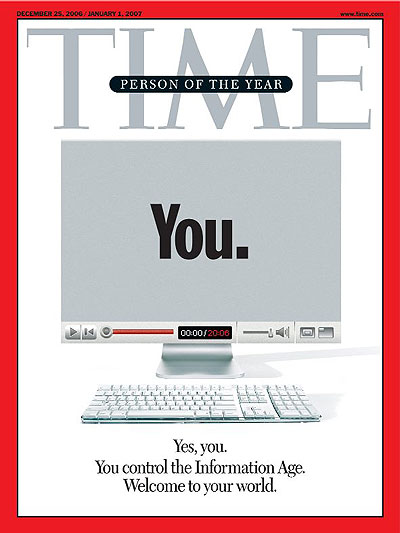
Culture Shock 01.11.07: Why 'You' became Person of the Year
Many in both the "establishment media" and the blogs greeted Time magazine's choice last month of "You" as Person of the Year with jeers and sneers.
Was Time, itself a charter member of the Media Establishment, pandering to its readers? Did Time's editors really think "You" deserving over, say, President Bush, Barak Obama or those nuts in Iran and North Korea? Were Time's editors, like some fortysomething father of three, trying, pathetically, to be hip? What gives?
Then, a few days later, what passes for the Iraqi government hanged Saddam Hussein, making him not only an ex-dictator, but an ex-Saddam. And soon afterward, low-resolution footage of the whole affair — stop, drop and snap, taken with a camera phone — debuted on the wildly popular Web site YouTube.com. By now, it's probably the most-watched snuff film since JFK rode past the grassy knoll.
For once, Time magazine was right. You are the person of 2006.
Saddam's execution was meant to be shrouded in secrecy. But because of the Internet, now everyone can judge for themselves whether it was just or simply revenge for Saddam's decades of oppression. What I think doesn't matter. Thanks to YouTube, you can draw your own conclusion.
This is the breakthrough of the Internet. Until recently, the Internet was much like every other medium that had dominated before it. Like print, radio and television, it was largely one way — people in power talking to you. Now, with the rise of easy-to-use Web sites like Blogger, LiveJournal, MySpace and YouTube, which debuted in 2005, the Internet truly runs in both directions. You can talk back.
You no longer have to know the first thing about computer programming to have your own Web site, filled with your own thoughts, opinions, photographs and videos. Now, there is no gatekeeper, no middleman preventing you from finding an audience. While the big music and movie companies whine about diminishing profits and illegal downloads, amateur bands and filmmakers are posting their own material on MySpace and gaining a following.
The leak of the Saddam video proves that "You" — that is, anyone — can drive a story. But it's not such huge, headline-grabbing stories that, in the end, really matter. No, what matters are the millions of small stories being told by millions of people who now have a way to talk to the entire world.
Compared to biological evolution, cultural evolution occurs in the blink of an eye. Now it will occur even more rapidly. As the average person produces more and more content for the Internet, more and more ideas are subject to its great, electronic feedback loop, which weeds through them like the cyberspace equivalent of natural selection. Charles Darwin meets Bill Gates.
Post a video to YouTube, and viewers can rate it. Write a blog, and you live or die by the number of other sites that link to you. It's the same power Roman emperors wielded in the Coliseum, only dispersed among billions of thumbs and only metaphorically fatal.
Of course, there is still a place for one-way media. We all spend more time consuming content than creating it. But the ratio of consumption to creation is no longer as lopsided as it was.
There is a lot more creativity out there than before. And You are responsible.
Thursday, January 04, 2007
Culture Shock 01.04.07: 'Lio' brings macabre humor to comics pages
If you're a reader of The Daily's comics pages, you've probably already noticed the change. Gone is longtime favorite "FoxTrot," and in its place is newcomer "Lio."
Changes on any newspaper's comics page don't come easy. Every strip has its following — although what some of you see in "Family Circus" I'll never understand. Drop one strip, and the outcry is so intense that you'd think you'd been caught drowning puppies.
But this time, the change was forced upon us when "FoxTrot" cartoonist Bill Amend decided to scale back his workload. He is now drawing only the Sunday strip, which The Daily still carries.
Normally, I'd be extremely upset by all of this. "FoxTrot," along with "Dilbert" and "Mutts," is one of my favorite strips, not counting reruns of "Peanuts." But even I must admit that we and other newspapers that have started carrying "Lio" in place of "FoxTrot" have traded up.
When I first learned about "Lio," I read all of the old strips going back to May 15, when it began syndication. I was amazed. No kidding, "Lio" isn't your typical comic strip.
"Lio" has a surreal, sometimes even macabre sense of humor that owes more to Charles Addams' "Addams Family" cartoons for The New Yorker than to anything currently appearing in the funny pages.
The title character is a little boy and aspiring mad scientist with a menagerie of bizarre pets — including a squid — and a habit of encountering menacing characters, from vampires and extraterrestrials to ants bent on world domination and the kite-eating tree that once menaced Charlie Brown.
Speaking of Charlie Brown, it's also not unusual for Lio to meet other comic-strip characters, or reasonably facsimiles. In one strip, Lio meets a homeless man with a small, stuffed tiger. The man is a thinly disguised Calvin from Bill Watterson's late, lamented strip "Calvin and Hobbes."
And the man has a sign that says, "Retired too early. Please help."
Part of Lio's charm is that he is keenly aware that he is a character in a comic strip. "Lio" is certainly not the first postmodern comic strip, but it is one of the few since "Krazy Kat" to bring a consistently postmodern, absurdist sensibility to daily newspapers.
The man behind "Lio" is Mark Tatulli, who also writes and draws the strip "Heart of the City" and is post-producer for the cable TV shows "Trading Spaces" and "A Wedding Story."
Tatulli, 43, who lives in Philadelphia, describes "Lio" as a pantomime strip with minimal text and seldom any dialogue.
The drawings tell the stories. That means each strip demands more attention than it takes to get the latest iteration of a Garfield-hates-Mondays joke.
With the retirement of Watterson, the demise of Gary Larson's "The Far Side" and the passing of "Peanuts" creator Charles Schultz, some have wondered if there is any life left in the daily comic strip. And, as an industry, daily newspapers have not helped matters, as we've been forced to scale back the space we devote to comics.
But "Lio" gives me hope that the daily comic strip may yet have some life left.
Thursday, December 28, 2006
Culture Shock 12.28.06: James Bond gets real, but Superman returns as a phony
Two icons returned this year, one with renewed relevance, the other creaking under his own pretensions.
Strangely, James Bond, the character who shouldn't work divorced from his Cold War origins, showed new energy. Meanwhile, the supposedly timeless Superman, remained as stiff and lifeless as ever, not so much the Man of Steel as the man of rigor mortis.
Daniel Craig's steely eyed Bond in "Casino Royale" is as close as the movies have come to capturing the ruthless, flawed character of Ian Fleming's novels. The new Bond is lean, mean and rough-hewn. He fits in comfortably with the threats of the 21st century.
The clear divide between East and West, communist and capitalist, is gone. The good guys won, and, apart from Cuba and North Korea, even the communists are capitalists now. The new map is a fractured landscape of terrorists, crime syndicates and rogue states. You have to be nimble to keep your footing, and Craig's Bond shows us that he is — both literally, during the movie's foot-chase sequence, and figuratively, by actually growing as a character.
Superman, however, never grows. Officially, he is the champion of truth, justice and the American way, however vaguely defined. But in practice, he is the heavy-handed enforcer of the status quo and the Establishment. He started as the poster boy for the New Deal and, later, 1950s conformity. In the 1980s, writer/artist Frank Miller realized this and cast Superman as a puppet of a corrupt government in his graphic novel "Batman: The Dark Knight Returns."
This year, as played by Brandon Routh in "Superman Returns," Superman is an uneasy combination of underwear model and savior. Director and co-writer Bryan Singer sees Superman as a divine figure. He especially goes overboard with a scene in which Lex Luthor's henchmen beat the Kryptonite-poisoned Superman nearly to death in the mud. It's all shamelessly reminiscent of Mel Gibson's "Passion of the Christ."
Singer leaves no doubt that he thinks Superman, the strange visitor from another planet, is way better than us mere humans. While Miller distrusts authority and gives us a Superman degraded by his close proximity to it, Singer gives us a morally superior overlord. Miller has faith in humanity, while Singer puts his faith with the gods on Mount Olympus.
After the failures of Iraq and Katrina, Singer's faith in the great leader seems quaint at best and dangerous at worst. Worse still, his Superman is a cipher. You can read into him whatever values you like, but that doesn't mean you'll be right. Superman is like a politician who gives pleasant speeches utterly free of content. He's Barack Obama.
Dressed up as an ennobling figure, the Superman of "Superman Returns" is really a cynical reflection of everything wrong with the world — a pretend savior who can't deliver.
Meanwhile, the James Bond of "Casino Royale" may be a cynical killer, but he is honest about who he is. He is a blunt instrument in a messed-up world — an everyman hero, but cooler. His way of fixing things isn't pretty, but it's better than waiting for Superman to save us.
Thursday, December 21, 2006
Culture Shock 12.21.06: Non-Christian elements of Christmas there from start
'Twas the week before Christmas, Bill O'Reilly in view
Shouting on the TV as his face turns Yuletide hue.
While his Fox pal John Gibson wrote a book just to say,
"There's a 'War on Christmas'! Purchase your copies today!"
OK, I'll stop now. You get the point. But, really, enough with the "war on Christmas" stuff already. With the shopping and the crowds, folks have enough to worry about without opportunistic blowhards making up a controversy.
Putting the name aside for a minute, Christmas has never been just about Christ. Early church fathers set the date for Christmas to coincide with (and co-opt) pre-existing pagan festivals centered on the winter solstice. Pagan elements have been with the holiday ever since, including the venerable Christmas tree. In fact, it was exactly such non-Christian aspects of the holiday that led many Protestants to virtually ignore Christmas until the Victorian era.
If you think Christmas is "too commercial," blame those same Victorians. They started the commercialization of Christmas back in the late 1800s, along with its transformation into a semi-secular holiday of gift giving and family togetherness. It's that commercialization that made Christmas "safe" for Christians who had religious objections to the celebration.
If keeping the Christ in Christmas meant leaving out everything else, then the result wouldn't really be Christmas. Besides, if O'Reilly and Gibson are looking for a fight, someone should tell them they've already lost.
The secular side of Christmas is firmly part of American culture, and it goes deeper than Rudolph, Frosty, saying "Happy Holidays" instead of "Merry Christmas" and bland Christmastime love songs by The Carpenters played ad infinitum.
The secular Christmas won when "A Christmas Story," the 1983 comedy about a boy's quest to get the ultimate present — a Red Ryder BB gun with a compass in the stock and a thing that tells time — replaced "It's a Wonderful Life" as Christmas Day marathon viewing.
"A Christmas Story" is our new seasonal fairy tale. And it's all about presents and commercialism, with a dash of (dysfunctional) family togetherness tossed in for good measure. It doesn't have a manger scene, but it does have a Little Orphan Annie decoder ring.
The movie appeals to Americans because it appeals to the child in us all. Sure, my childhood Christmas is several decades removed from the early 1940s Christmas of Ralphie and his Red Ryder. For me, it was an Atari 2600, but the spirit is the same. We associate particular Christmases with what we got, and that reminds us of where we got it.
Given its diverse origins — Christian, Roman, Germanic, etc. — it's only proper that Christmas has returned to being a near universal celebration. It's observed even in Japan, where it's become strangely associated with romance and dining on KFC.
Christmas is both secular and religious, commercial and spiritual, Christian and pagan. It has something to offer everyone, including a message of "peace on Earth and goodwill toward men." The wording may be Christian, but the sentiment has many sources.
Thursday, December 14, 2006
Culture Shock 12.14.06: 'Star Trek's' 40th birthday flies past at warp speed
Somehow, the year is almost gone. And yet hardly a word has been said about 2006 marking the 40th anniversary of an American institution.
It was in 1966, by way of the 23rd century, that the starship Enterprise set forth on its storied five-year mission. But four decades later, “Star Trek” has entered turbulent seas, or their outer-space equivalent.
For the first time since 1985, “Star Trek” is absent from both TV and movie screens, unless you count reruns. The only “new” Trek to be had is the 1973 animated series, which made its long-awaited debut on DVD last month, and the original series, returned to syndication with new, high-tech special effects in place of the ’60s-vintage models and matte paintings.
While it’s sad to see Trek’s anniversary pass quietly in the night, the Franchise, as it’s become known, clearly needs a rest. Its decline in quality, starting with the final two seasons of “Star Trek: The Next Generation” and reaching rock bottom with “Star Trek: Voyager” and “Enterprise,” made a breather inevitable. Simply put, the creative team in charge of the Franchise at the bitter end had nothing left.
“Star Trek” had gotten away from the original vision of creator Gene Roddenberry and producer Gene L. Coon. And the attempt to recapture some of that frontier spirit during the last season of “Enterprise” couldn’t overcome that show’s dull, backward-looking premise. Prequels, by definition, don’t boldly go where no man has gone before.
The next “Star Trek” film, reportedly planned for 2008, is also rumored to be a prequel. If so, Trek’s keepers haven’t learned their lesson yet.
The original “Star Trek” was inspirational. Literally. You don’t have to look far to find scientists, engineers and astronauts inspired to enter their chosen fields by “Star Trek.”
But who could be inspired by Trek’s recent incarnations? By the time “Enterprise” was canceled, Trek was looking inward, at its own increasingly convoluted past, not outward.
Oddly enough, while “Star Trek” is slowly becoming a parody of itself, many of the people who have long lived in the Franchise’s shadow are finally emerging.
After winning two Emmy Awards for his portrayal of “Boston Legal” attorney Denny Crane, it’s safe to say that William Shatner has found a role to finally rival, if not eclipse, Capt. James T. Kirk. Leonard Nimoy has left behind Mr. Spock and found a new calling as a photographer, mostly photographing nude women, which is nice work if you can get it. Even George Takei, better known as Lt. Sulu, has moved on, recently taking a supporting role on the hit NBC series “Heroes.”
Sure, lots of “Star Trek” fans, too many in fact, will fawn all over anything bearing the Trek logo.
But those of us who really care about Roddenberry’s creation deserve better. And we’re willing to wait for it. No “Star Trek” at all is better than Trek in name only.
Still, the lack of recognition on Trek’s 40th anniversary is almost shameful. You can be sure that George Lucas won’t let 2007 pass without everyone on the planet knowing that it’s the 30th anniversary of “Star Wars.” And, if anything, the “Star Wars” franchise is even more tarnished than the Trek franchise.
What was I just saying about prequels being a bad idea?
Thursday, December 07, 2006
Culture Shock 12.07.06: Science fiction's outsiders find new respectability

There are snooty critics who see it symptomatic of civilization's decline. But the American literary canon is finally expanding to encompass some of our most influential, yet neglected, writers.
The Associated Press reported last week that the Library of America will release in 2007 a volume devoted to science-fiction writer Philip K. Dick. Although there is no shortage of Dick's stories in print, this is significant news because the Library of America is the closest thing the U.S. has to an official literary gatekeeper. If the L of A publishes your work, you are a Significant Author. To be part of the Library of America is to be one with Faulkner, Fitzgerald, Hawthorne and Melville.
"Philip K. Dick: Four Novels of the 1960s" is scheduled for publication in June. It will include the novels "The Man in the High Castle," "The Three Stigmata of Palmer Eldritch," "Ubik" and "Do Androids Dream of Electric Sheep?" The last of those was made into the 1982 Harrison Ford movie "Blade Runner."
Jonathan Lethem is editing the volume. Lethem, author of "Motherless Brooklyn" and "The Fortress of Solitude," is considered a "literary" author, although he actually has written quite a bit of genre fiction, including the futuristic "Gun, with Occasional Music." But although Lethem sometimes writes science fiction, his books aren't marketed as science fiction. He isn't confined to the ghetto as was Dick, who died in 1982.
And he's happy to do his part to assist Dick's escape. In an interview with the blog The Elegant Variation, Lethem said, "I'm helping preside over the utter and irreversible canonization of one of my (formerly outsider) heroes ..."
But Dick's ascendance to the literati firmament wouldn't mean much if it were merely an isolated incident. It isn't.
Last year, the Library of America elevated an even more unfairly maligned and neglected figure of genre fiction: H.P. Lovecraft. And it was the positive response to "Lovecraft: Tales" that helped spawn the Dick collection, according Max Rudin, Library of America publisher, in an interview with the AP.
Lovecraft is America's most important horror writer since Edgar Allan Poe, although, like Poe, he seems to have earned greater respect in France, for whatever reason.
The works of science fiction/fantasy writers Ray Bradbury and Ursula K. Le Guin could be the subject of future L of A volumes, Rudin said.
Genre writers are at last getting their due, just three years after the National Book Foundation controversially gave Stephen King its Distinguished Contribution to American Letters Award and sent the snobs into apoplectic fits.
"But giving an award like this to a guy like me suggests that in the future things don't have to be the way they've always been. Bridges can be built between the so-called popular fiction and the so-called literary fiction," King said in his acceptance speech.
It's a two-way street. When Philip Roth, an undeniable member of the Literary Establishment, delves into science fiction with an alternate history novel like "The Plot Against America," it becomes far harder for critics to ignore those who've plowed the fields of SF for decades. Then the critics might learn that Roth's plot is such a cliche in SF circles that even most hacks wouldn't touch it without giving it some new twist.
If mainstream critics are forced to read unapologetic science fiction, horror and fantasy, there's no telling who will be admitted to the canon of respectable literature next. I suggest Harlan Ellison.
Thursday, November 30, 2006
Culture Shock 11.30.06: O.J. book, interview could become karmic payback
Last week, the New York tabloids and cable news pundits were buzzing about O.J. Simpson's canceled book, "If I Did It," which was going for thousands of dollars on eBay.
I have no problem with people making a buck off the few copies of O.J.'s book that slipped through the cracks after the publisher, HarperCollins, recalled copies that already had been shipped to stores. The only person I don't want making money from "If I Did It" is O.J. Simpson.
A quick search of eBay on Sunday afternoon, however, turned up no copies of "If I Did It" for sale. According to an eBay spokesman, the online auction site is removing the book at HarperCollins' request. This is no surprise, as eBay routinely removes items at the request of big media companies.
But my search for "If I Did It" did turn up someone selling a poster of Simpson.
The poster depicted an intense — one might even say "mean" — Simpson from his football days. And beneath the photo of O.J. was the caption, "If I Did It?" Emphasis on the "if."
Next, I searched YouTube to see if O.J.'s canceled two-part Fox interview had been leaked to the Internet. I've got to hand it to Fox, they've managed to keep a lid on the interview so far. All I found was a nine-second video called "Bootleg OJ Simpson Interview." It's simply a still photo of O.J. followed by the caption, "Why would you sick (expletive deleted) support OJ by watching his interview???"
Now, as I see it, watching a bootleg of O.J.'s interview isn't supporting him. If anything, it's ripping him off, which makes it a good thing.
Unless Beelzebub has a devil put aside for him, O.J. has escaped justice. Incompetent prosecutors and delusional jurors saved Simpson from prison. And even though Simpson lost a civil lawsuit, he has yet to pay a penny to the families of Ronald Goldman and Nicole Brown Simpson.
The only weapon we have left against O.J. is ridicule. Which is why I want his disgusting and absurd book and interview to leak out to the public. Only then can skilled comedians and amateur filmmakers pick apart every sentence and every frame and turn them back on Simpson.
Face it, the jokes about how O.J. won't rest until he finds the "real killers," who are hiding on some golf course or in some strip bar somewhere in America, are getting old. We need new material.
You may be thinking that it's a worse punishment for O.J. simply to ignore him rather than to pay him the attention necessary for ridiculing him. And you may be right. But there is more to this than O.J.
I'm thinking of all of the people who cheered when O.J. got off. I'm thinking of all the people who think O.J. is actually innocent.
There are people in this country who believe lots of downright stupid things. They believe extraterrestrial beings from planets hundreds of light years away come to the Earth just to dissect cattle and anally probe farmers.
But it's a rare occasion when people actually get punished for believing stupid things. A rare example occurred on Jan. 1, 2000, when a lot of people woke up to find that the world's computers had not failed, civilization had not collapsed, and the thousands of dollars of survival gear in the basement was not a good investment.
O.J.'s book and interview could have been a long-overdue case of karmic comeuppance for everyone who actually thought he was innocent. If they leak to the Internet, they still could be.
Thursday, November 23, 2006
Culture Shock 11.23.06: The War on Thanksgiving, the forgotten holiday
I gather today is some sort of holiday. Now what is it? Turkey Day? No. That's not right. Oh, yes. Thanksgiving. How could I forget?
Well, it's easy to lose track of a holiday that has been squeezed almost to a singularity by the juggernauts of Christmas and Halloween.
In terms of the amount of money Americans spend on them every year, Christmas and Halloween are easily the country's two most popular celebrations. And that's even without anyone getting a paid day off for tricks or treats.
Thanksgiving is under assault. You might as well call it "Official Start of the Christmas Season Eve." People used to get upset when stores and shopping malls put up Christmas decorations before Thanksgiving. Now, some stores put them up before Halloween. Some people complain about a "War on Christmas," in which Christmas is losing ground to other, more "politically correct" holidays. But Christmas has it easy compared to Thanksgiving.
Yes, dear readers, whether you've noticed it or not, we're in the midst of a War on Thanksgiving. And Thanksgiving is folding faster than the Polish cavalry in front of a Panzer division. It's time to take sides.
So, let me be clear about this — Down with Thanksgiving!
Now, nobody is going to quibble with a day off work, so assume that if we abolish Thanksgiving, we'll get something else in return.
Let's face it. What's Thanksgiving for? Giving thanks? Well, if that's all, I don't need a holiday to do that, and if I do, how thankful am I, really?
Mostly, Thanksgiving is for watching football and family gatherings. The last time I checked, there was no shortage of pro football on TV, even on days not devoted to the ritual consumption of poultry.
But what about all that family togetherness? That's all well and good, I suppose, if watching Aunt Margaret and Aunt Jill down a dozen glasses of sherry between them and then argue about which one of them Grandma really wanted to have the good china is your idea of a spectator sport.
Maybe Charles Schulz can help us? After all, the beloved creator of Charlie Brown and Snoopy did write a cartoon to explain the true meaning of Christmas. Nope. The only life lesson I've taken away from "A Charlie Brown Thanksgiving" is that jelly beans and popcorn do not go over well as Thanksgiving dinner.
Maybe Thanksgiving is simply the day when we remember the Pilgrims, who, according to all the history books, came to America in search of religious freedom.
I hate to burst your bubble — well, actually, this is the sort of thing I live for — but the Pilgrims didn't come to the New World for religious freedom.
When they first left England, the Pilgrims went to Holland, the most tolerant society the world had seen up to that time. The Pilgrims had all the religious freedom there they could stand. In fact, they had too much, and were aghast that their children were taking advantage of the freedoms Holland offered. So, they packed up and came to America, not to get religious freedom, but to get away from it.
Other people can celebrate that sort of thing if they want, but count me out.
Thursday, November 16, 2006
Culture Shock 11.16.06: Pop culture's diversity is its strength
If there is one thing about which pundits both left and right agree, it's that American culture is rotten. So rotten, in fact, that it threatens the rest of the world.
On the left, author John Tirman includes TV and pop culture among his list of "100 Ways America Is Screwing Up the World." On the right, Karen Hughes, a longtime advisor to President Bush, was quoted recently saying, "One of the things I hear a lot, particularly in deeply conservative societies, is that parents feel kind of assaulted by American culture."
Oddly enough, the disgust of high-culture elitists on the left and the alarm of cultural moralists on the right share the same source. American culture is, in fact, more robust, more vibrant and more populist than ever before. And that, to many on both sides of the political spectrum, is exactly the problem.
We live in a world of 100-plus channel TV, and with a TiVo, you can, for all practical purposes, program your own station. If that isn't enough, you can now download many TV shows via the Internet, often free of charge, as with Fox's offerings at MySpace.com. And if you're still not satisfied, even the most obscure shows of years gone by are available on DVD.
The Golden Age of Television isn't the bygone era of "Mr. Ed." It's today. Sure, you probably think 90 percent of everything on TV is a waste of time, and I agree. But there is now unprecedented diversity in American television. Competition between broadcast and cable TV stations, combined with growing competition from the Internet, is driving up the quality of that 10 percent of programming that is worth watching.
But what constitutes that 10 percent depends upon whom you ask. If you ask me, the SciFi Channel's "Battlestar Galactica" is not only the best show on TV, it's one of the best shows ever, and Fox's "House" runs a close second.
Other people swear by "Lost" or "Grey's Anatomy," which are perfectly respectable choices, too. And others still worship at the altar of "American Idol," proving there's no accounting for taste.
But even if I hate "American Idol," that's not the point. I'm sure there are lots of people who would never watch "Battlestar Galactica." The point is, TV is now big enough for all of us. We're not limited to three broadcast networks plus British imports on PBS.
In the "good old days," TV was aimed at a mass audience. It was OK. We liked it. But is there a single show of the so-called Golden Age (besides the original "Star Trek") that inspires the rabid devotion of today's cult hits?
Today's shows are aimed at a far more fragmented audience. Shows don't have to be everything to everyone. We can point our satellite dishes upward at a galaxy of possibilities.
TV isn't alone. Over-the-air radio may seem increasingly bland, but with iPods and the ability to download music and talk programming from the Internet, there is something for everyone. Literally.
If "The Simple Life" is the price I have to pay for "Boston Legal," so be it. I don't have to pay attention to Paris Hilton, and you don't have to watch William Shatner. But at least we both have a choice.
Tuesday, March 28, 2006
The (super) power of words
The Los Angeles Times weighs in against Marvel and DC's joint trademark of the term "super hero" and its variations:
(Link via Neilalien.)
In trademark law, the more unusual a term, the more it qualifies for protection. We would have no quarrel with Marvel and DC had they called their superheroes "actosapiens," then trademarked that. But purely generic terms aren't entitled to protection, at least in theory. The reason is simple: Trademarks restrict speech, and to put widely used terms under private control is an assault on our language.
(Link via Neilalien.)
Friday, March 24, 2006
P is for PAD
Make a note of this moment because this will probably never happen again: I agree 100 percent with Peter David:
What he said. Now, go read the entire post and the comments.
If I see one more article about Alan Moore being "swindled" by DC or how Hollywood has destroyed his graphic novel, I'm going to go on a vendetta of my own.
What he said. Now, go read the entire post and the comments.
Monday, March 20, 2006
Super thieves
SF writer Cory Doctorow is mad as hell about Marvel and DC's joint attempt to monopolize the term "super-hero":
(Link via Neilalien.)
"Super-hero" isn't Marvel's property. They didn't invent the term. They aren't the only users of the term. It's a public-domain word that belongs to all of us. Adding a ™ to super-hero is a naked bid to steal "super-hero" from us and claim it for their own.
(Link via Neilalien.)
February by the numbers
ICv2.com has posted its monthly breakdown of comics sales: the Top 100 graphic novels and the Top 300 floppies. The return of Astonishing X-Men gave Marvel the No. 1 slot on the Top 300, but DC held it's own, filling half of the top 10 spots, including two issues of Supergirl and two issues of Green Lantern. (How on Earth did Supergirl become a top 10 book?)
The circulation of 13 of the top 25 floppies was up over their previous issues.
Sunday, March 19, 2006
B is for box office
V for Vendetta did anything but bomb this weekend, taking in an estimated $26.1 million on 3,365 screens to debut at No. 1. Box Office Mojo crunches the numbers:
Dystopian visions of the future frequently have trouble finding an audience in theaters, from Blade Runner to The Island, Brazil to Equilibrium. Throw in a potentially off-putting protagonist in its always-masked freedom fighter, and V for Vendetta was a tough sell, rendering its opening a solid success despite industry speculation that it could bow to north of $30 million.
Subscribe to:
Posts (Atom)